ORGANIC URBANISM

(2) Teaming up with nature

Teaming up with nature

Organic urbanism is a method of city-making based on the gradual building of areas with their residents. That is its first definition.

But it is also, more broadly, a way of making the city with nature, according to nature, for nature: in this view, the city and nature are not separate realities. The natural and the artificial are not foreign worlds that should be kept apart or set against each other: on the contrary, nature can make the city more habitable; and the city, in reality, is also what makes nature habitable.

For what is a city, if not a piece of nature that has become more habitable than another? More habitable thanks to its streets, its buildings, its homes for all, but also its waterways, its parks and its gardens?

And indeed: what is a piece of “wild” nature if not an area inaccessible to humans? Deserted by humans? Or quite simply: spared by humans because, to a very large extent, humans have decided to live grouped together in hamlets, villages and cities?

The density of urban morphology and the richness of living things are two sides of the same process: sparing and sharing. Building and planting. Dwelling and gardening. Constructing and maintaining, one plot after another.

It is this same development process, at once natural and artificial,

✼ that spares nature by forming small towns, hamlets, villages and cities.

✼ and that allows us to live with it, where we have chosen to live and work, when we plant and garden as we come together.

The street villages and coconut plantations of the Bến Tre urban area, in Vietnam, 120,000 people. Natural? Artificial? Or both at once? The categories through which, from above, we think about, plan and regulate our living environments are tools too simple, binary and abstract to help us grasp, understand, imagine, organise and ultimately allow to happen what gives life to the areas we inhabit: the action, the work and the art of residents, builders, gardeners, growers, shopkeepers…

The founding principles

✼ Grouping housing together spares nature: at the scale of an area, densifying one place preserves the soils and habitats of all the others;

✼ Sharing the city enriches it: in the dense urban fabric, the richness of biodiversity stems from the fragmentation of plots, which multiplies gardens, edges and habitats;

✼ Buildings support and protect nature: walls, roofs and façades offer shelter, shade and support that nature does not find elsewhere; they become habitats in their own right;

✼ Nature, too, supports and protects the city: it adorns it, cools it, helps to manage rainwater, and feeds and heals those who live there;

✼ Maintenance is the key: more than the area or the number of trees planted, it is the care, the number and the diversity of active gardeners that will make nature in the city rich and lasting.
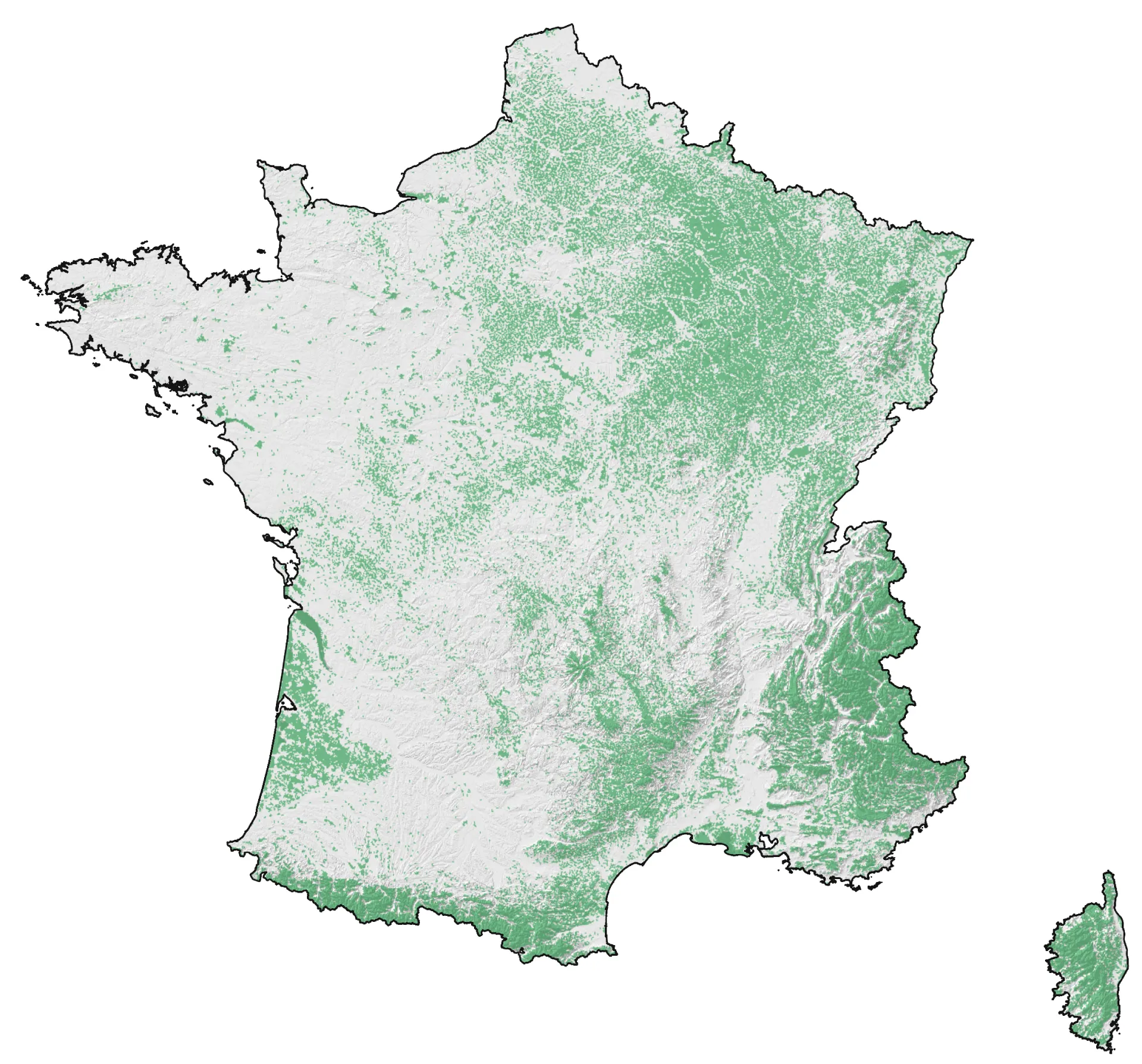
France divided into 1 km x 1 km squares. The green squares are uninhabited: no one lives there. 37% of the squares in the country are uninhabited (INSEE, 2017)

Sparing nature

We need housing, business premises and public buildings. And every building has to be built somewhere: on a plot that is already built on, in an already urbanised area, or on a new plot that will eat into land preserved until now.

Densifying what already exists, rather than sprawling, means sparing everything around it:

✼ the farmland that feeds cities;

✼ natural soils, which nothing can restore within a human lifetime;

✼ the large continuous spaces through which wild species move;

✼ forests, meadows and wetlands, which retain water and store carbon.

Densifying one place means protecting all the others. The first way of making the city with nature, for nature, according to nature, is therefore to group housing together in the city in order to spare natural habitats: what ecologists call land sparing.
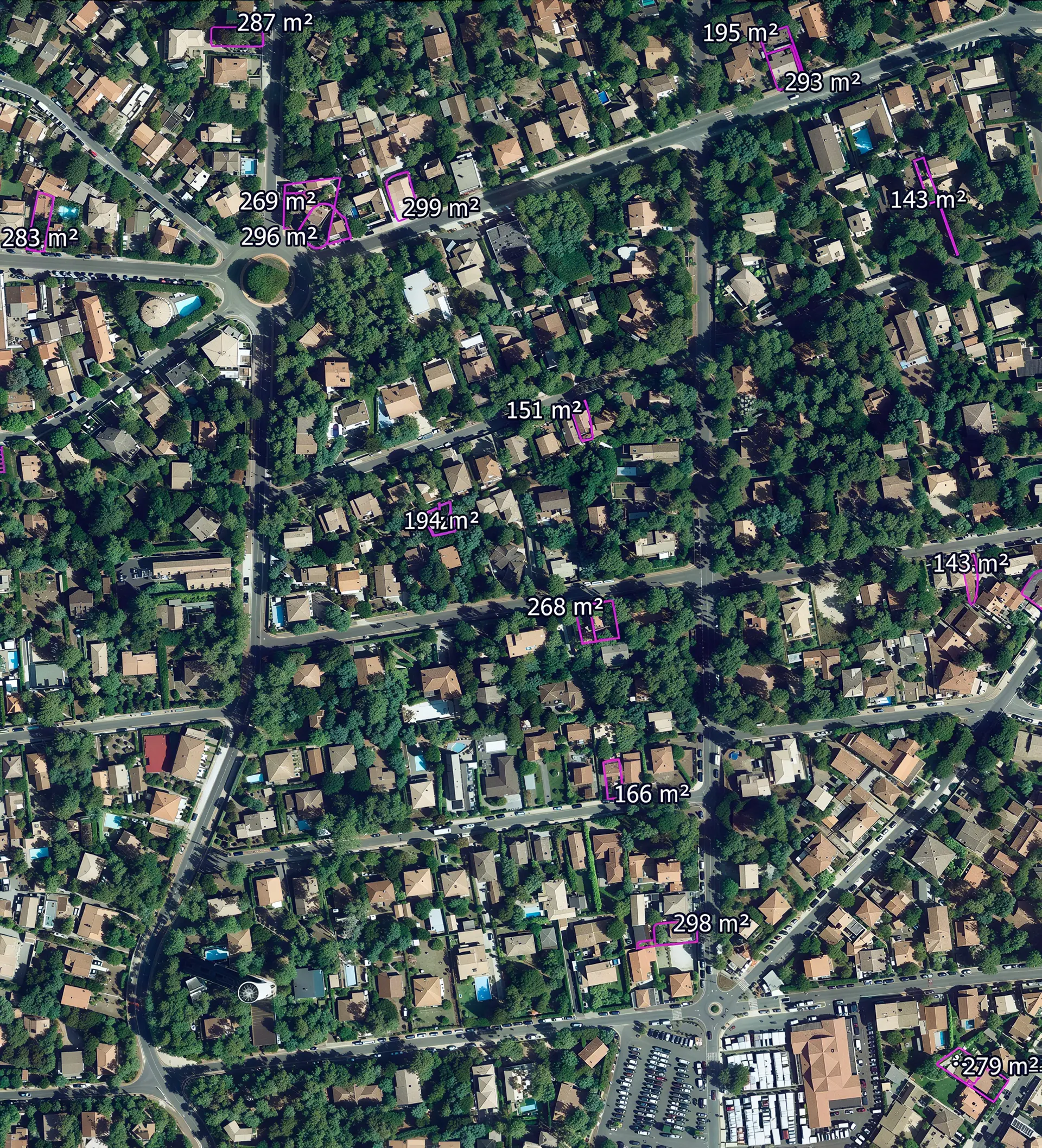
Lège Cap Ferret. There is no serious reason — ecological, technical, democratic, or from the point of view of social justice — why every French person who wishes to should not be able to enjoy a small garden of their own. An IFOP poll (February 2025) reveals that 67% of French people would be delighted to have a garden of 200 m² or less. As many as 24% even consider that 50 m² would be enough for them. By sharing the gardens of the some 20 million houses already built in France, we can ensure that a garden in the city ceases to be a privilege.

Sharing the city

It may seem counter-intuitive today, but grouping housing together, its spatial concentration, what is known as urban densification, are not incompatible with increasing the presence of nature in the city.

The second way of making the city with nature is to welcome it into our cities, not in order to drive out humans and their homes, but to live alongside it.

Nature in the city lives in a constrained environment. It needs to be protected, watered, sometimes cared for every day. It flourishes when it is left free, where it is not expected. But also when room is made for it, when it is gardened, pruned, maintained. It needs light, water, shade, and gardeners.

We plant trees to give ourselves shade, but they need it as much as we do. Setting density and compactness against nature is asking the wrong question. The urban heat island wrongly pits the artificial city against the natural countryside: this indicator measures a temperature difference between two categories, not the actual comfort of residents, and it leads us astray on the real levers of thermal comfort and climate adaptation. The dense, compact city can create the shade that protects living things. It is a matter of design, implementation and maintenance — not a simplistic choice between concrete and greenery.

The more gardeners there are, and the more diverse their practices, the better nature in the city will fare. For the richness of nature in the city depends less on the area granted to it than on the fragmentation that divides up the space it is given: a mosaic of a thousand small gardens, all different, is worth more than one large space maintained by a single hand.

Dividing a large plot to build a new home on it does not, therefore, harm nature: it helps to broaden the range of habitats and to welcome additional gardeners who can help it thrive in the city.

Densifying and gardening are two sides of the same action: bringing buildings and nature to coexist closely to create a living environment for us all. This is what ecologists call land sharing.

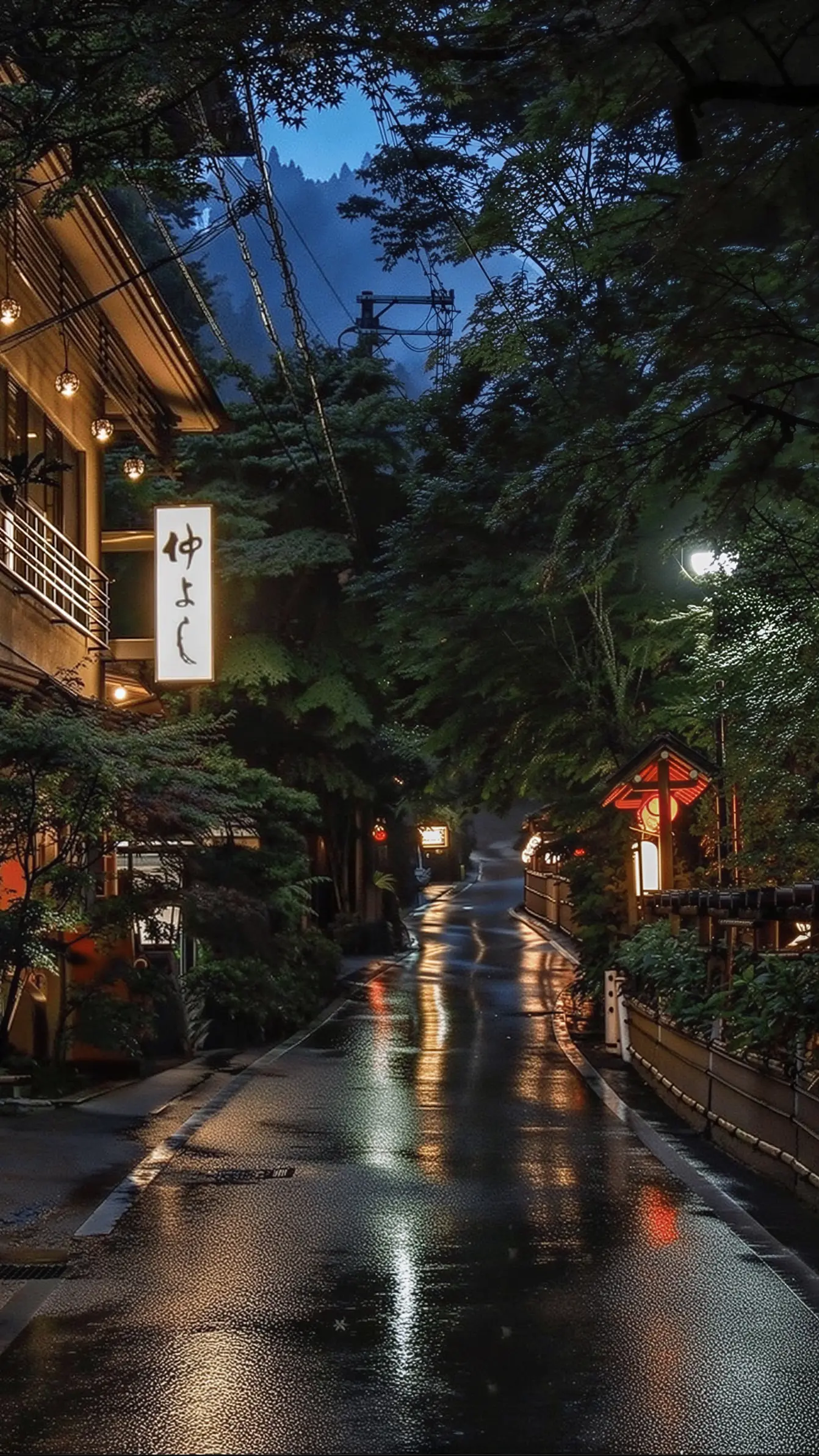
Sakyō-ku (Kyoto), Japan, 165,000 people. Village or forest?

Micro-gestures that help nature grow in the city

To make the city with nature, for nature, according to nature, we must give everyone back the power to garden it, gesture by gesture:

✼ a large garden shared between several gardeners;

✼ a hedge stretching along a new boundary;

✼ soil opened up here and there at the foot of a wall or a tree;

✼ a façade left to the birds and the climbing plants;

✼ flowering staggered to feed insects all year round,

✼ a patio built and planted to make it pleasant and cool.
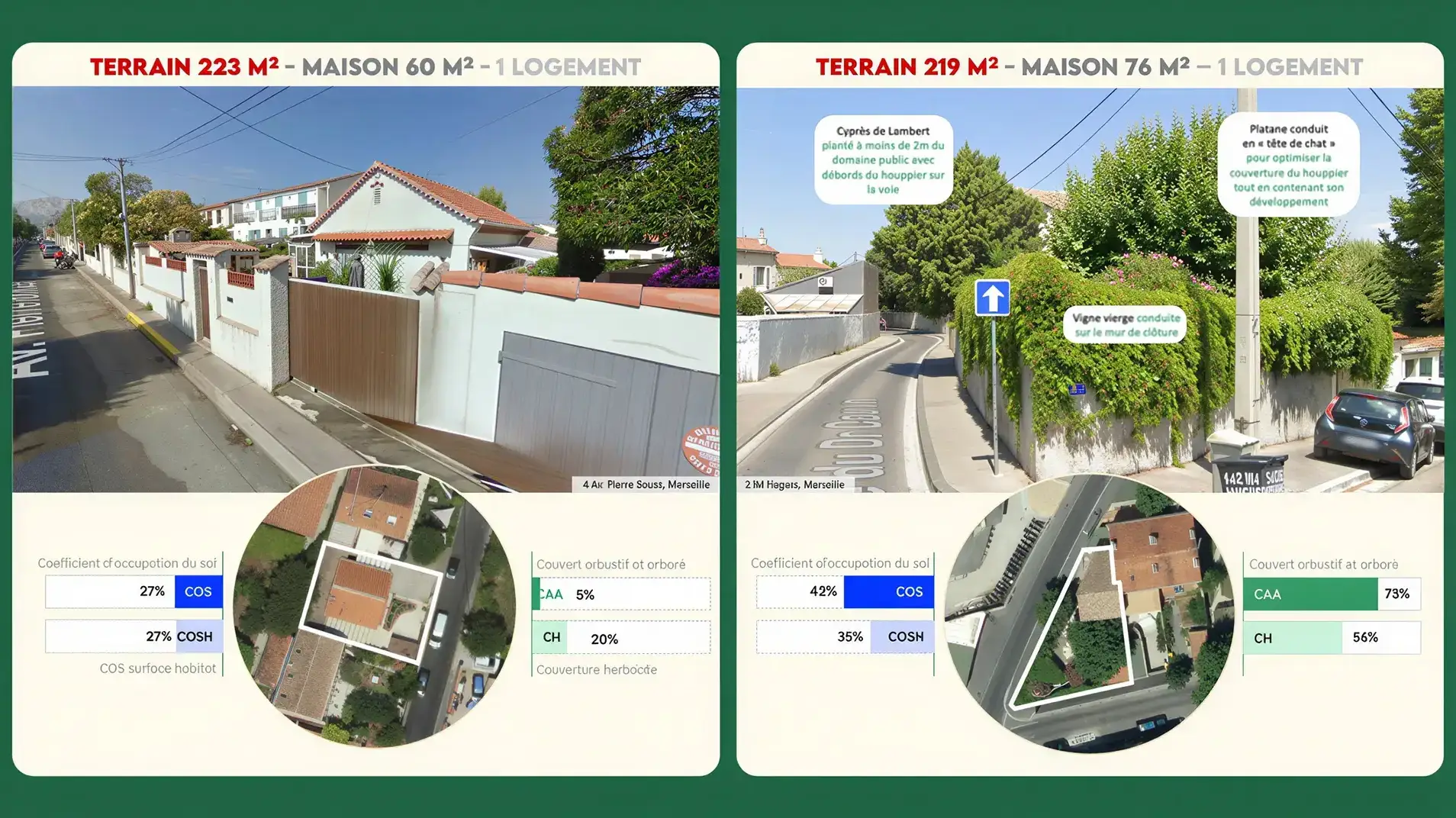
Aix – Marseille – Provence Métropole, Villes Vivantes: the same plot can be more built-up, more lived-in, more gardened, and therefore greener, all at the same time. Built density and the intensity of vegetation cover are not opposed; they are two variables that can increase together.

Taken one by one, these gestures are tiny. But across a neighbourhood, their accumulation transforms an expanse of sterile, hard-to-maintain lawn into a mosaic of rich habitats, belonging to a thousand gardeners.

This is how nature has always settled in cities. And this is how our single-family neighbourhoods, which today are a kind of green desert, can gradually become richer, one plot, one building, one hedge, one season at a time.

26,517 hectares of vegetation cover — trees, shrubs, grasses — recorded on private residential plots in Aix-Marseille-Provence: this is the sum of the work of all its gardeners. At equal built density, the greenest decile reaches 54% tree and shrub cover, compared with 26% on average. Twice as much. The difference does not come from the space available: it comes from the action of gardeners. Cerema reprocessed land files 2023 · IGN LiDAR HD 2021 · IGN BD ORTHO IRC · Villes Vivantes processing.

More gardeners means more life

The richness of nature in the city is not measured by the area left to it, but by the number and diversity of those who cultivate it and produce the mosaic of heterogeneous habitats that nature needs. It takes people to look after nature in the city.

A garden resembles the person who tends it: their history, their trade, their tastes, their way of doing things. Two neighbours never plant quite the same things and never tend them in quite the same way.

That is why a thousand small gardens, kept by a thousand different hands, shelter richer nature than one large space maintained by a single hand: where one repeats, the others vary. And each variation offers one more shelter, one more flower, one more season to small wildlife.
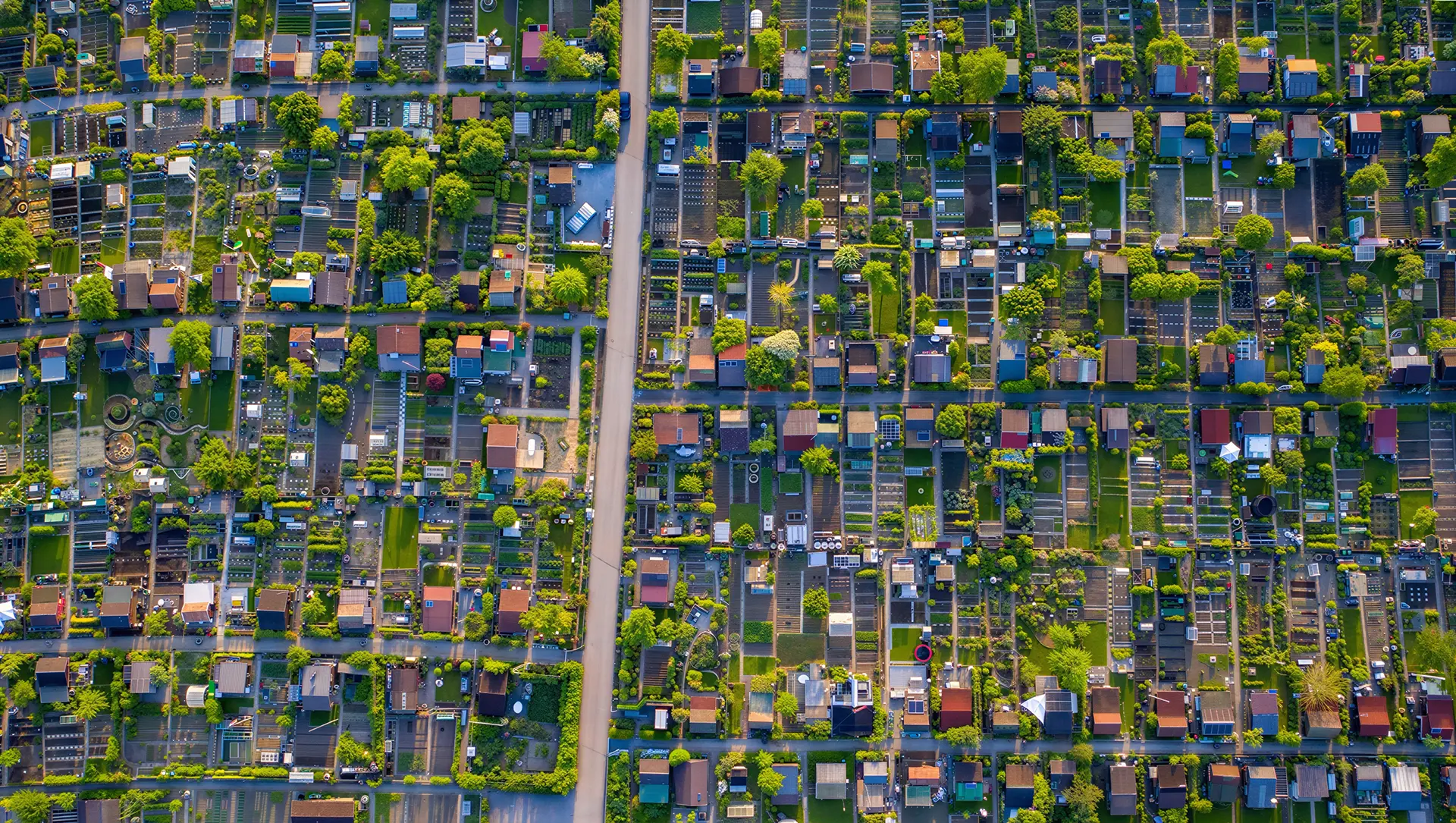
Allotments & private gardens: how plot division is democratising access to vegetable gardens. “Ten years ago, when we had a 250/300 m² plot, it was the last one to go: nobody wanted it because it was considered too small. Today it is the exact opposite: when a 300 m² plot becomes free, nobody takes it because it is considered too large! We have to divide them into two 150 m² plots so that they appeal to new gardeners.”

When nature and the city acclimatise to each other

We instinctively set buildings and nature against each other: ivy supposedly cracks walls, the city supposedly smothers trees, density supposedly leaves them thirsty. These fears describe accidents, sometimes mistakes, but certainly not an inevitability.

Well combined, buildings and nature can protect each other.
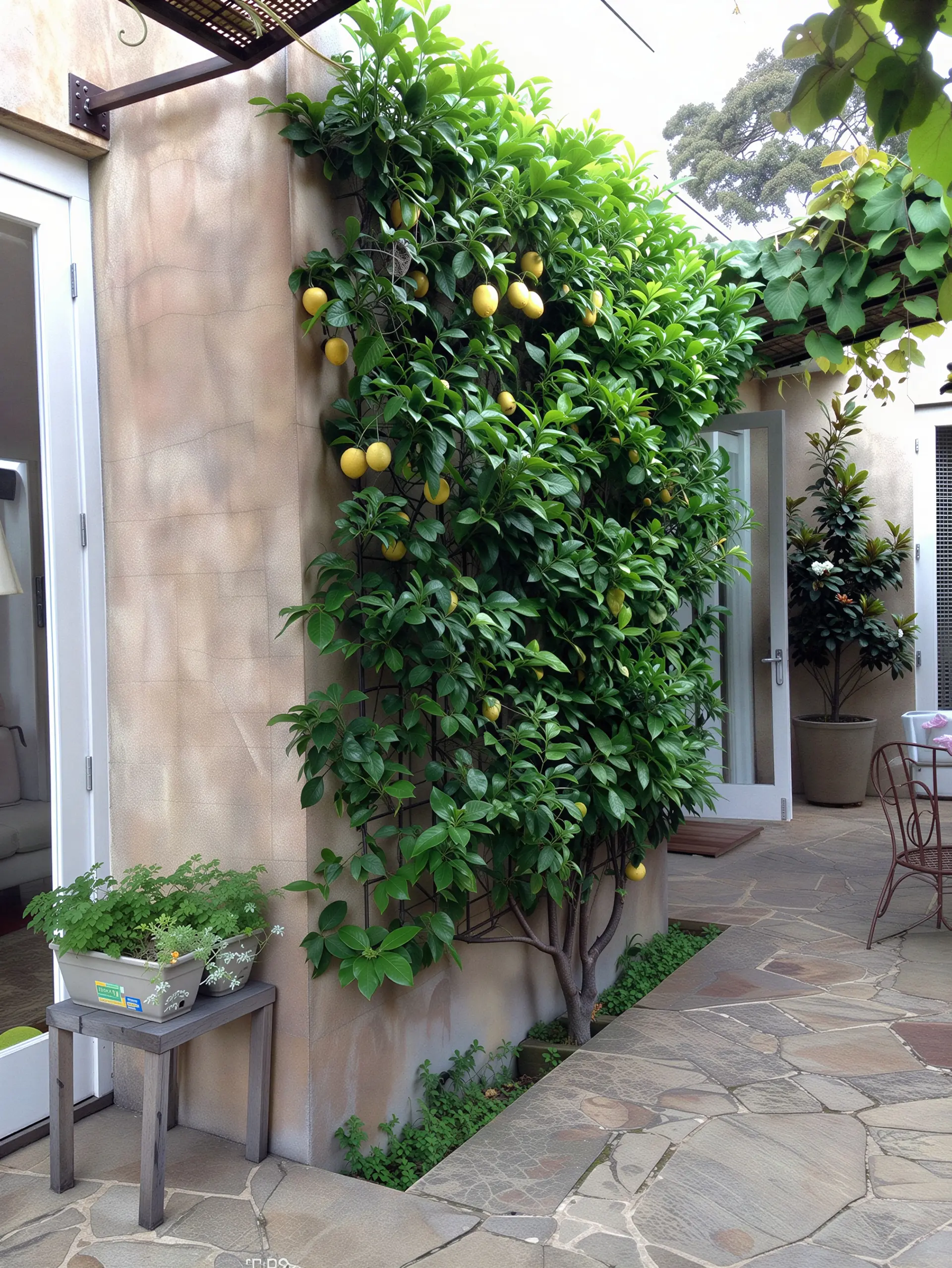
South-west exposure – ‘4 Saisons’ lemon tree. As early as the 13th century, Franciscan monks from the monastery of Gargnano introduced the lemon tree to the shores of Lake Garda, imported from the Ligurian Riviera. To grow this fruit tree outside its natural climatic range, they planted it against stone walls that create a microclimate. Facing south or south-east depending on the site, the walls store the heat of the day and release it at night, while blocking the cold north-easterly winds.

Buildings shelter nature. A wall, a roof, a façade offer fauna and flora what they could not find elsewhere. Birds nest in crevices, bats roost under roofs, plants from rocky habitats settle on façades. The city does not imitate nature: it invents habitats that did not exist and that can host it.
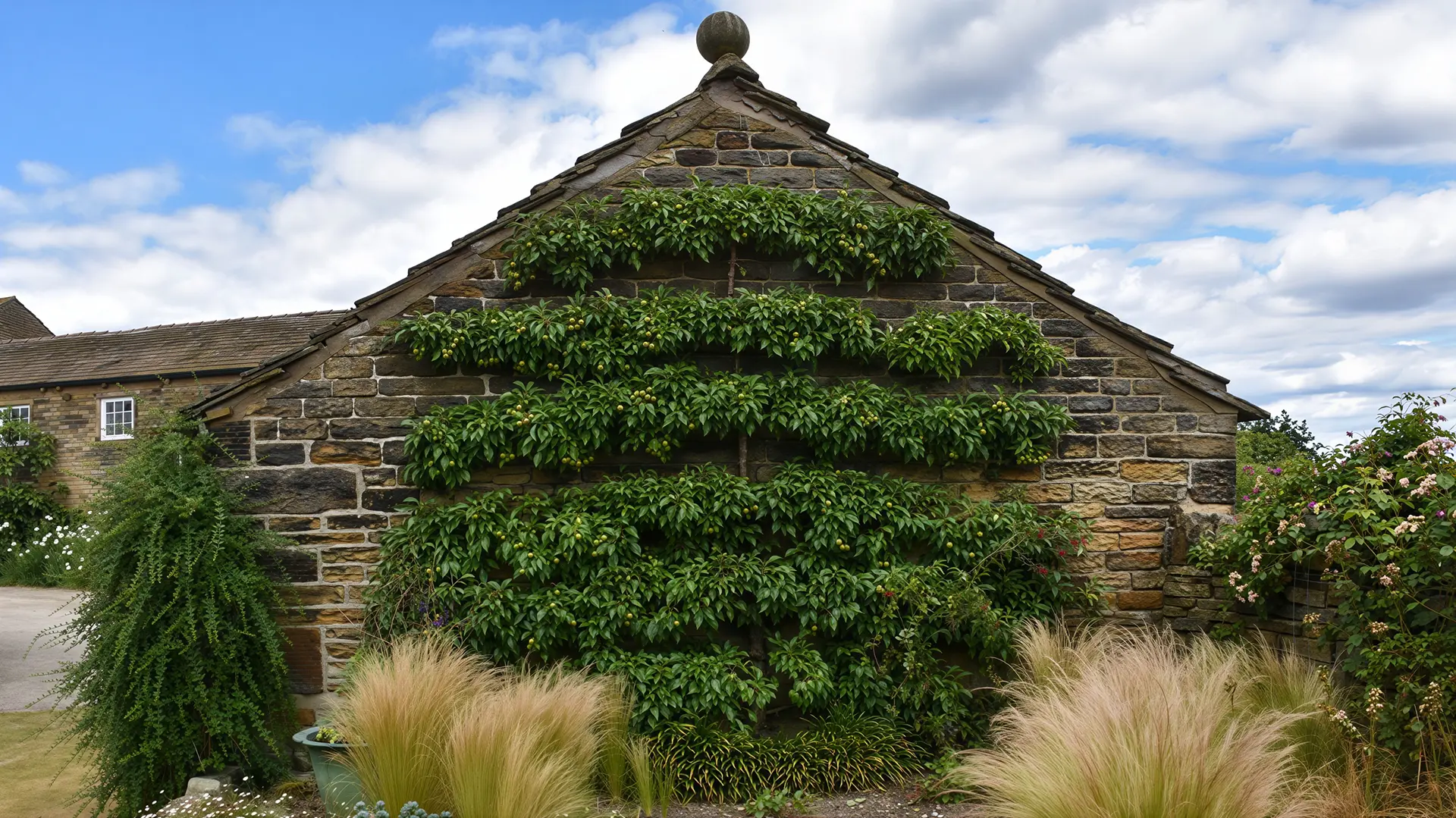
South exposure – Pear tree. Training pear trees as espaliers is a tradition in the north and east of France, where harsh winters make a wall essential for them to bear fruit. In Recques-sur-Hem (Pas-de-Calais) there are two remarkable pear trees — a Catillac on the gable wall, a Beurré Giffard along the façade — planted in 1860 and 1900, which are still pruned and harvested (100 kg in 2025) by the fifth generation of the same family.

Nature protects buildings in return. On a sound wall, ivy damages nothing: it does the opposite. It blocks the wind in winter, casts shade in summer, keeps rain and pollution at bay. A cloak that protects the wall and keeps it more temperate all year round. The plant does a service to the building that supports it.

What cools a street is shade, that of trees and buildings combined. Built shade does not only protect passers-by: it also protects trees, many of which already suffer from the heat. The trees we plant to shelter us also need sheltering.

Buildings and nature need not compete for space; they can intelligently acclimatise to each other. Organically. But these alliances do not happen by themselves: they have to be designed, built and planted, and maintained. This is how the city shelters nature, and how nature in return gives it far more than coolness.
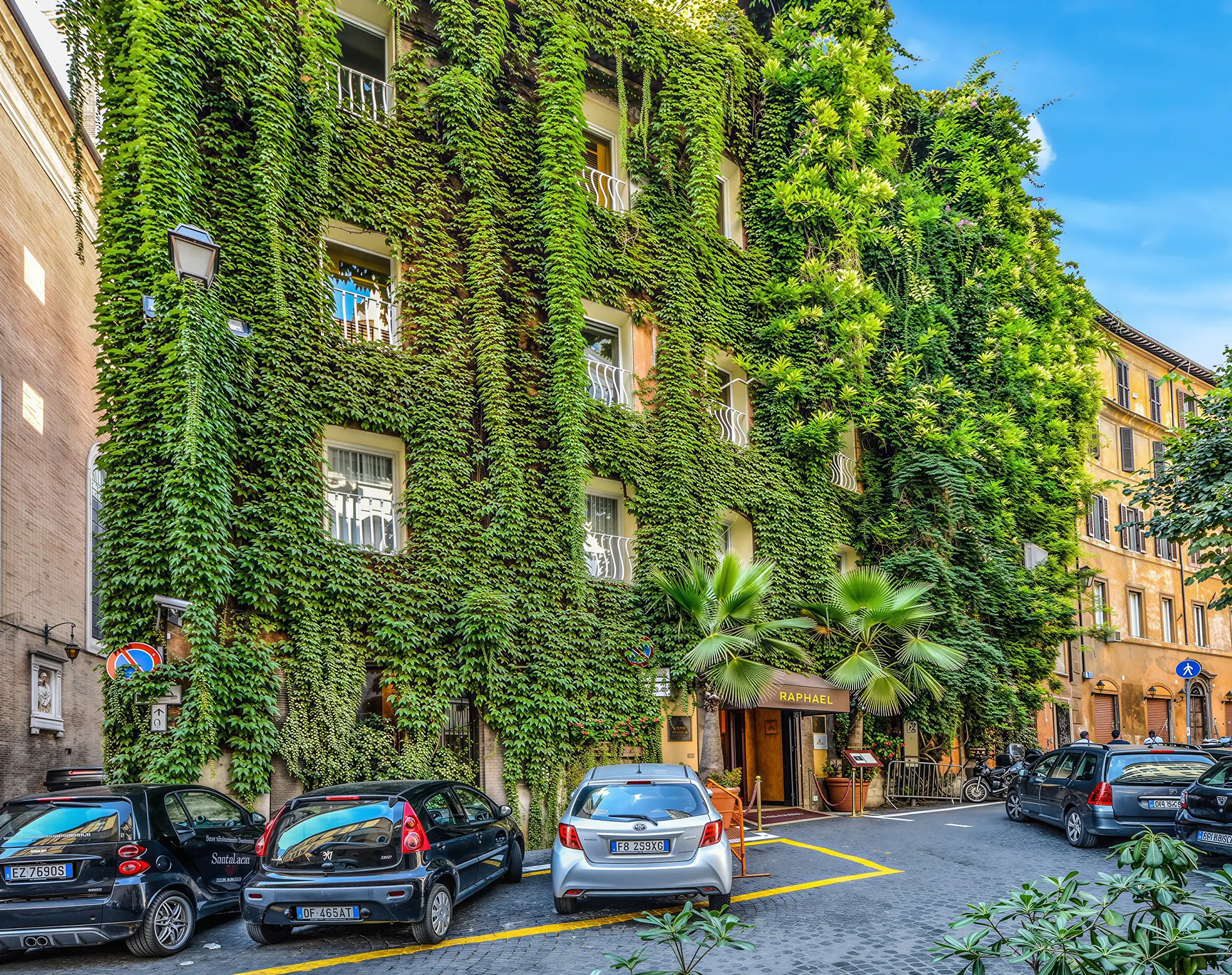
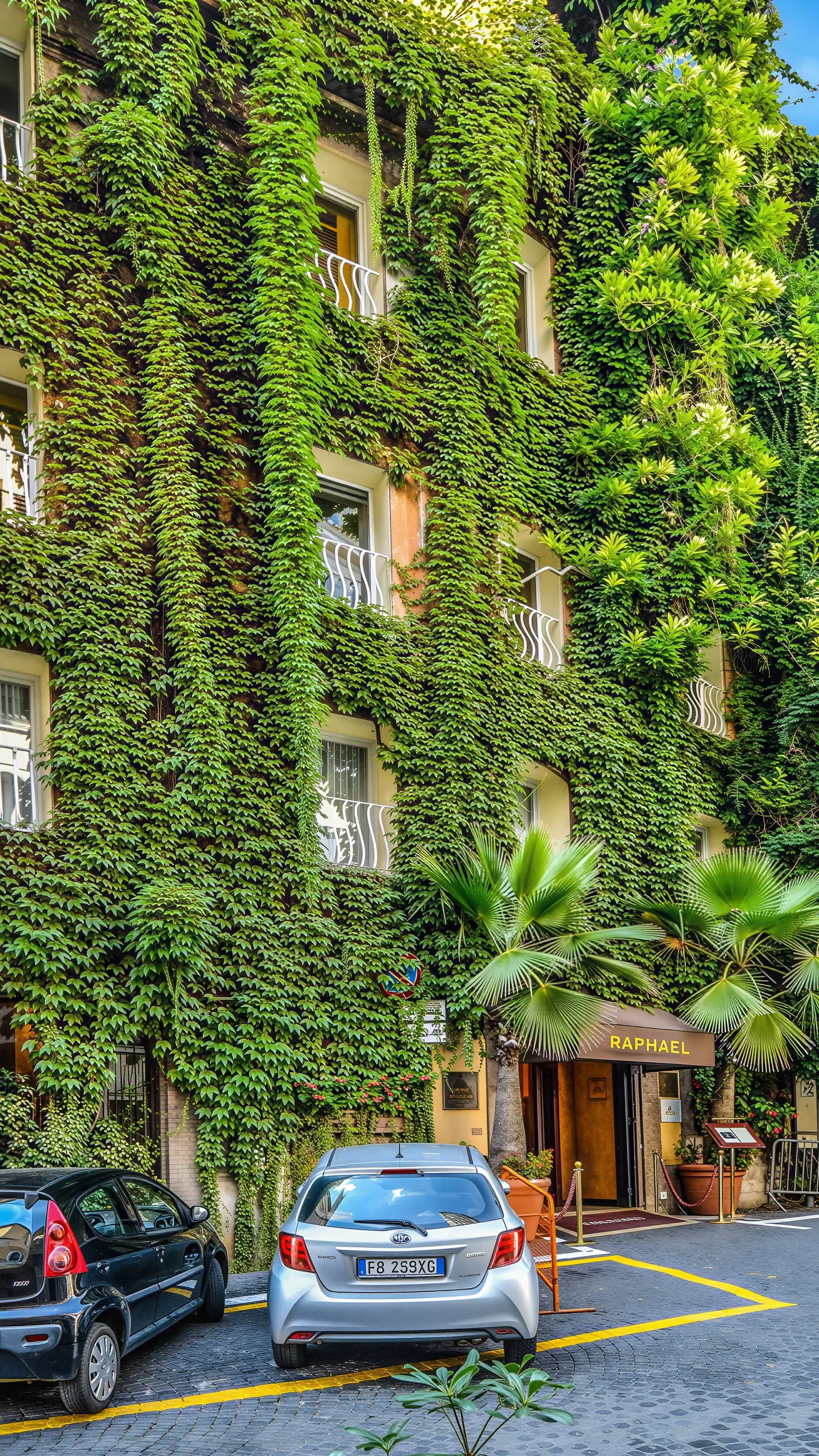
Climbing plants grown against a façade to a depth of 30 to 35 cm can lower the surface temperature to the level of the ambient air temperature, or even slightly below. The façade of the Hotel Raphaël, covered for decades by climbing plants, has become a landmark in the Roman cityscape: a curtain of Boston ivy (Parthenocissus tricuspidata), wisteria (Wisteria sinensis) and bougainvillea (Bougainvillea glabra) that changes colour with the seasons clothes this 17th-century building.

Multiplying gardens to welcome, feed, heal, delight, cool…

Nature in the city is not just beautiful to look at. A garden, even a small one, provides concrete services to those who live in it and cultivate it.

✼ It feeds: a vegetable garden of a few square metres, tended in detail, yields more than a large plot that is hard to keep up.

✼ It heals: a large Dutch study of nearly 800,000 people has established that having a private garden of at least 50 m² reduces most common illnesses by 15 to 24%.

✼ It delights: watching the seasons go by, a tree blossom, a bird nest: what a garden gives first and foremost is a grounding in the present and a sense of belonging to nature.

✼ It cools, thanks to a well-placed tree, a façade covered in leaves, a patio adorned with a pool and planting…

None of these benefits requires large spaces. They require gardens on a human scale, numerous and cultivated. That is why access to a private garden in the city should no longer be a privilege: given what it provides, putting it within reach of as many people as possible is a public health objective.
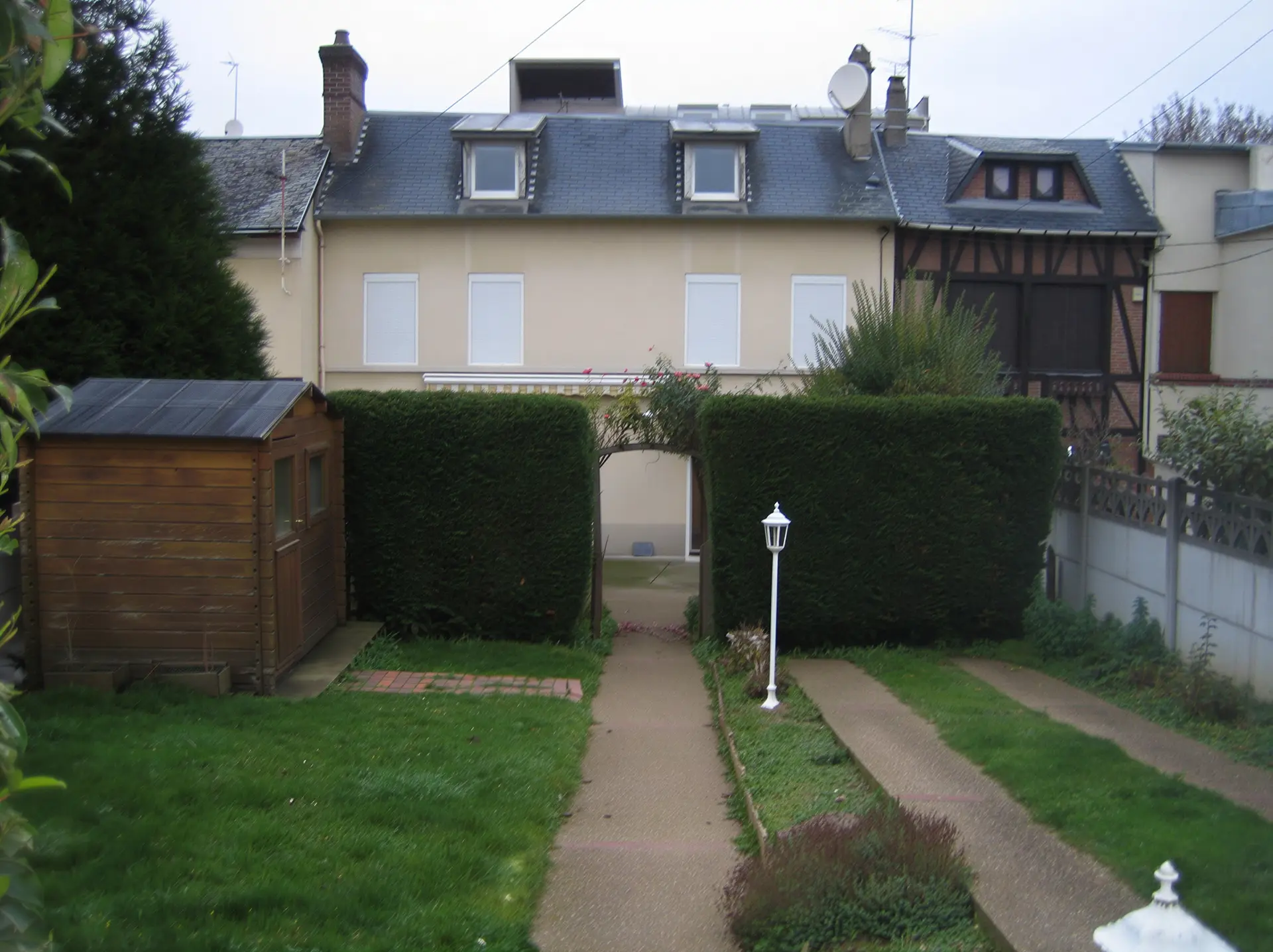
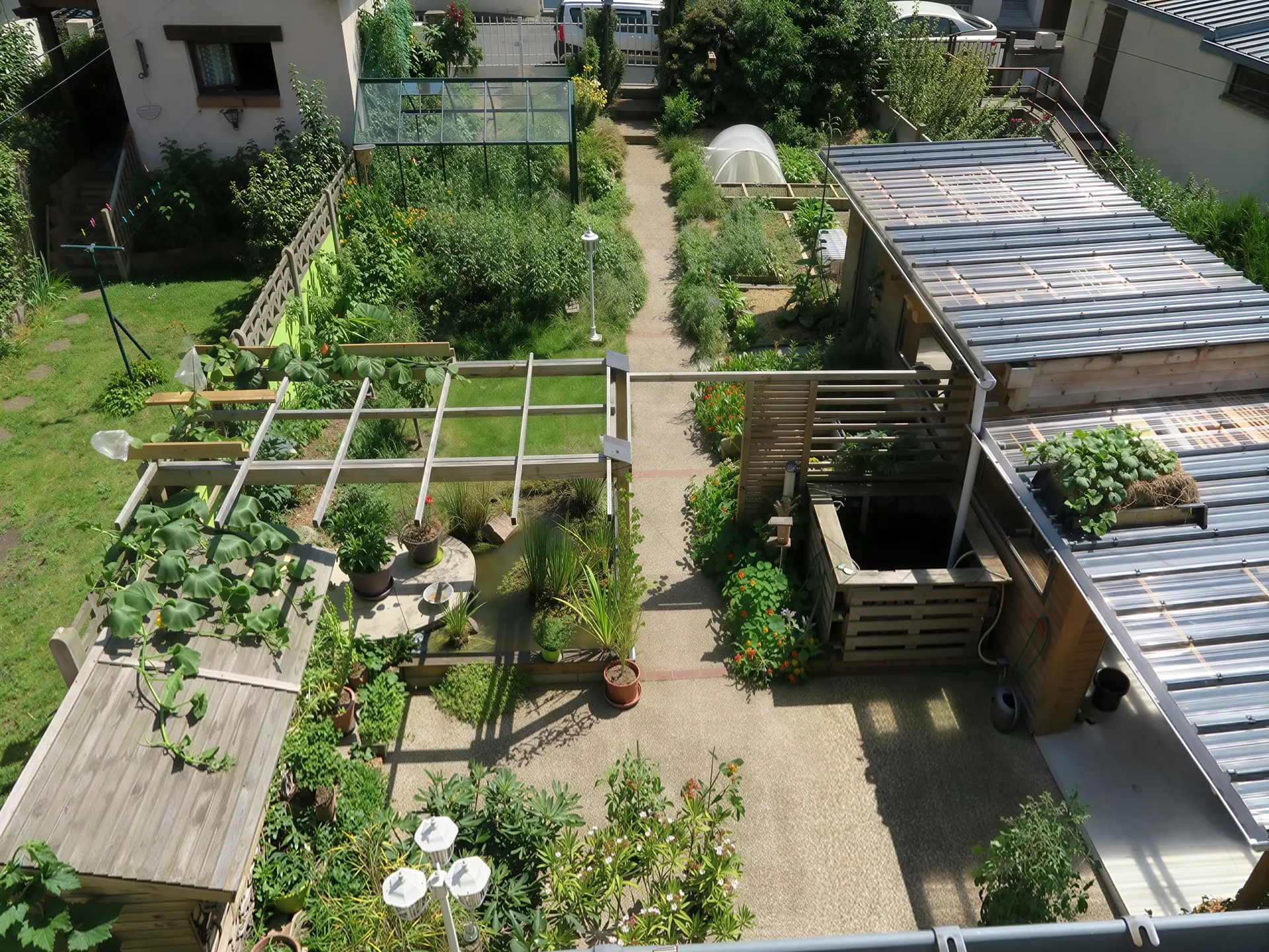
Before: an ordinary faubourg garden in Sotteville-lès-Rouen — concrete paths, lawn dominating, a “green desert” like so many others.
After six years of intensive, ecological gardening by Joseph Chauffrey, the same 150 m² plot produces 300 kg of fruit and vegetables a year, on just 45 m² actually cultivated (30 m² of vegetable garden, 15 m² of fruit trees) — i.e. 6.7 kg per cultivated m². His method: verticality, rapid successions, densification, and daily care that only a small area allows. According to the agronomist Jean-Paul Thorez, it is one of the most productive gardens in the world at these latitudes.

Four methods, doubly useful to nature

For some fifteen years, Villes Vivantes has been developing methods for putting organic urbanism into practice across areas. Each of these methods densifies what already exists and, in the same gesture, spares nature outside while helping to enrich it inside:

BIMBY: by sharing large plots in single-family neighbourhoods, we bring additional gardeners to places where lawns are hard to maintain, and we lengthen edges and hedges. And every home built here is a home that does not eat into natural, forest and agricultural land.

BUNTI: adapting, greening, reconfiguring and even transforming the existing building stock through upward extensions, extensions, and the creation of balconies, patios, terraces and town gardens.

BAMBA: designing the plot, the building project and the garden in a single movement, and paving the way for the custom housing development, in which each plot is adapted to its occupants, their practices and their gardening abilities.

BRAMBLE: concentrating housing in the right places means freeing up and preserving, elsewhere, the soils and ecological continuities that wild nature needs.

All these operational models pursue the same goal: in the city, more diversity, more heterogeneity, more intensity and more density. One plot at a time, through tailor-made projects adapted to the needs and aspirations of their future residents.
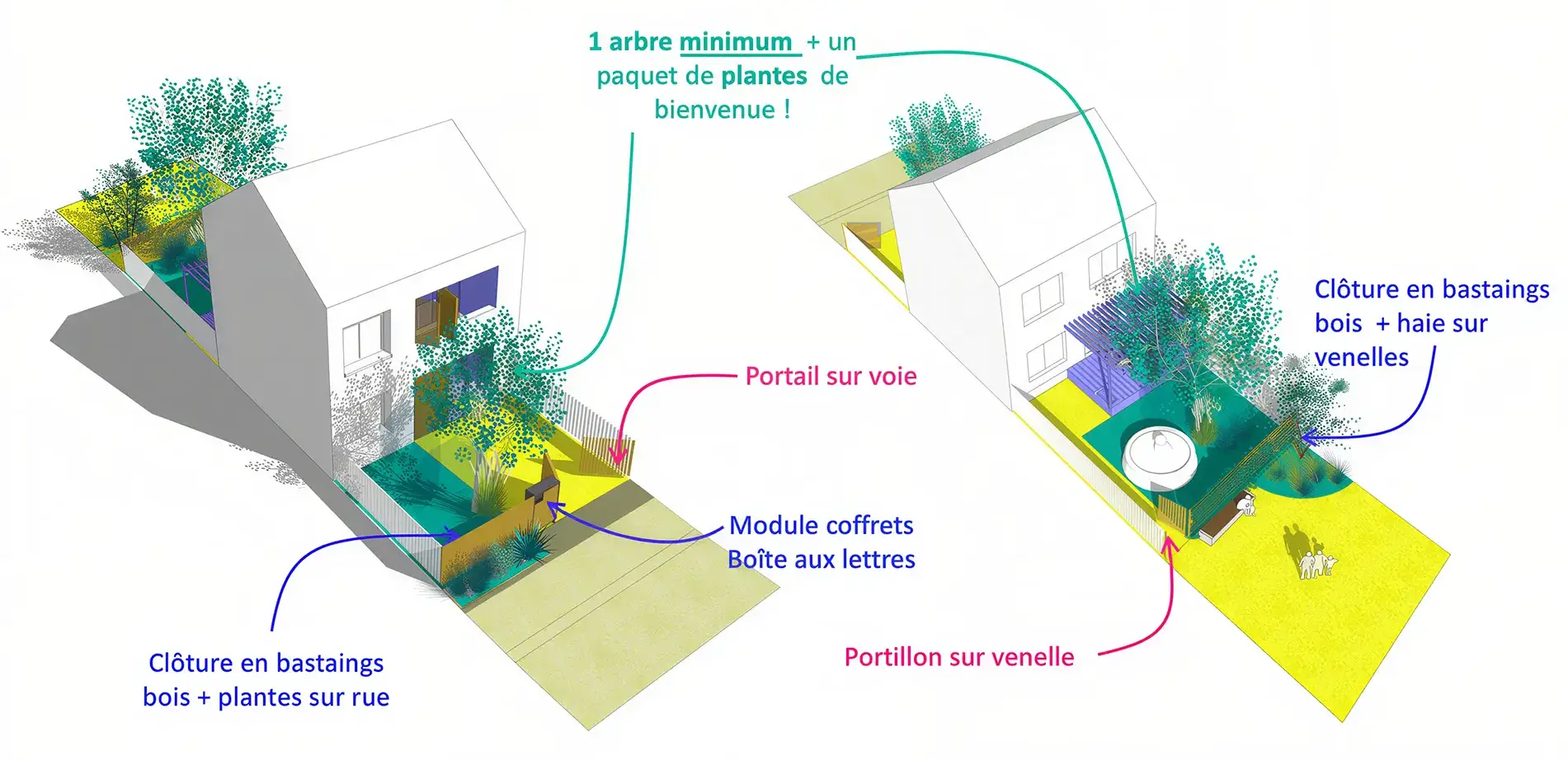
BAMBA operation led by Villes Vivantes in Clermont-Ferrand: fences, planting and support with architectural and landscape design are included in the sale of the building plots. Each garden is custom-designed with the resident who will bring it to life and garden it day to day. The choice of plants, their contribution to thermal comfort both outside and inside the home, and the organisation of outdoor uses are decided with the gardener so that the garden is tailored to them.

Evolving nature, an adapting city

A city’s nature is not a stage set installed once and for all: it changes with the climate, and we must change with it. The species we rely on are already living on borrowed time: in London, a study of more than a million trees showed that three out of four might not survive the climate of the end of the century. What we plant today will live in tomorrow’s climate.

No plan fixed in advance can respond to such a drift. Only continuous attention can, made up of trials, errors and adjustments, plot after plot, season after season.

This adjustment is within everyone’s reach. It does not require large gardens but gardeners who are more numerous, more attentive, inventive and free. Their diversity does more than enrich the city: it makes it robust. Nature tended in a thousand different ways becomes more resilient: should a disease strike, a heatwave hit or a species fail, others will take over.
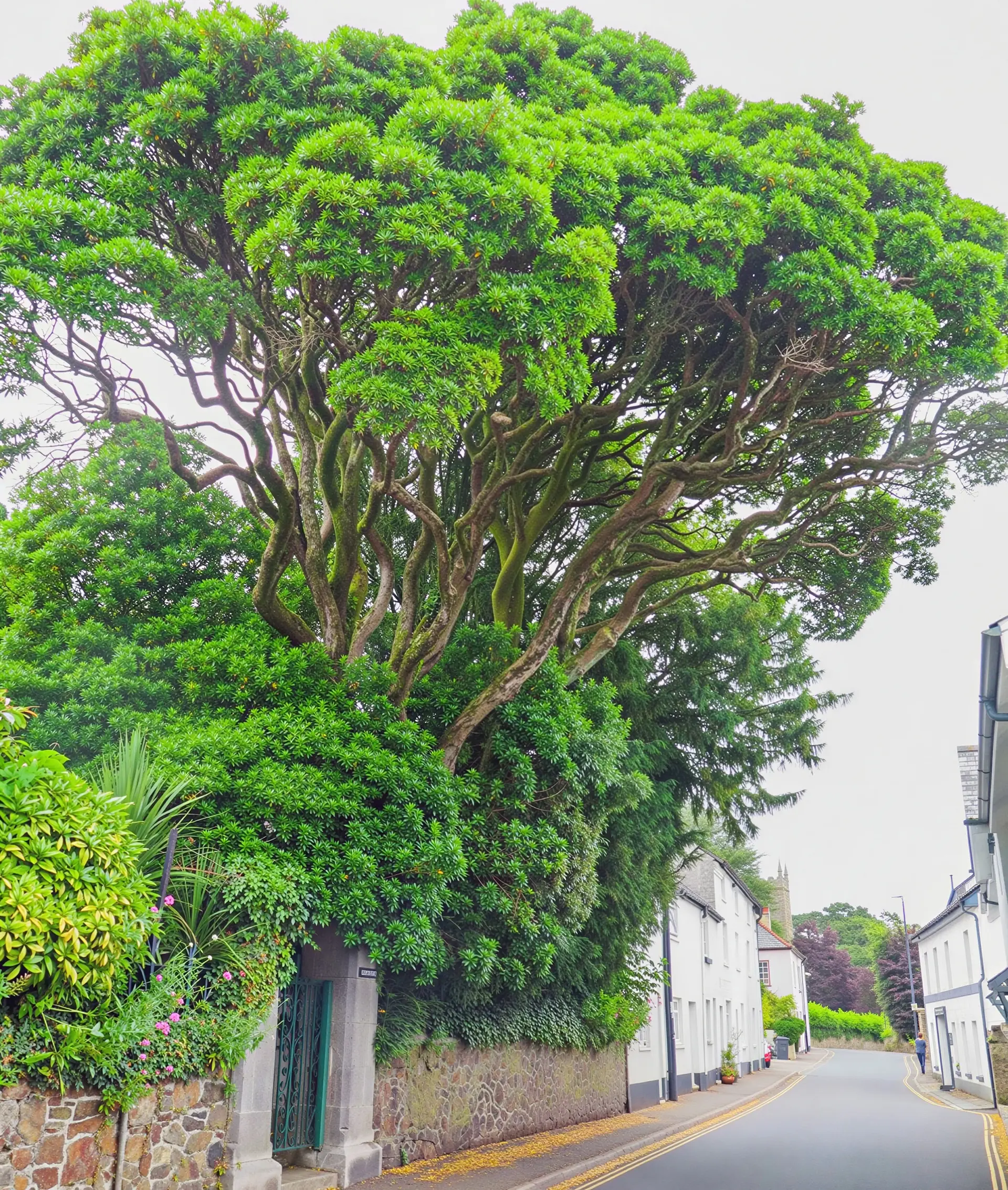
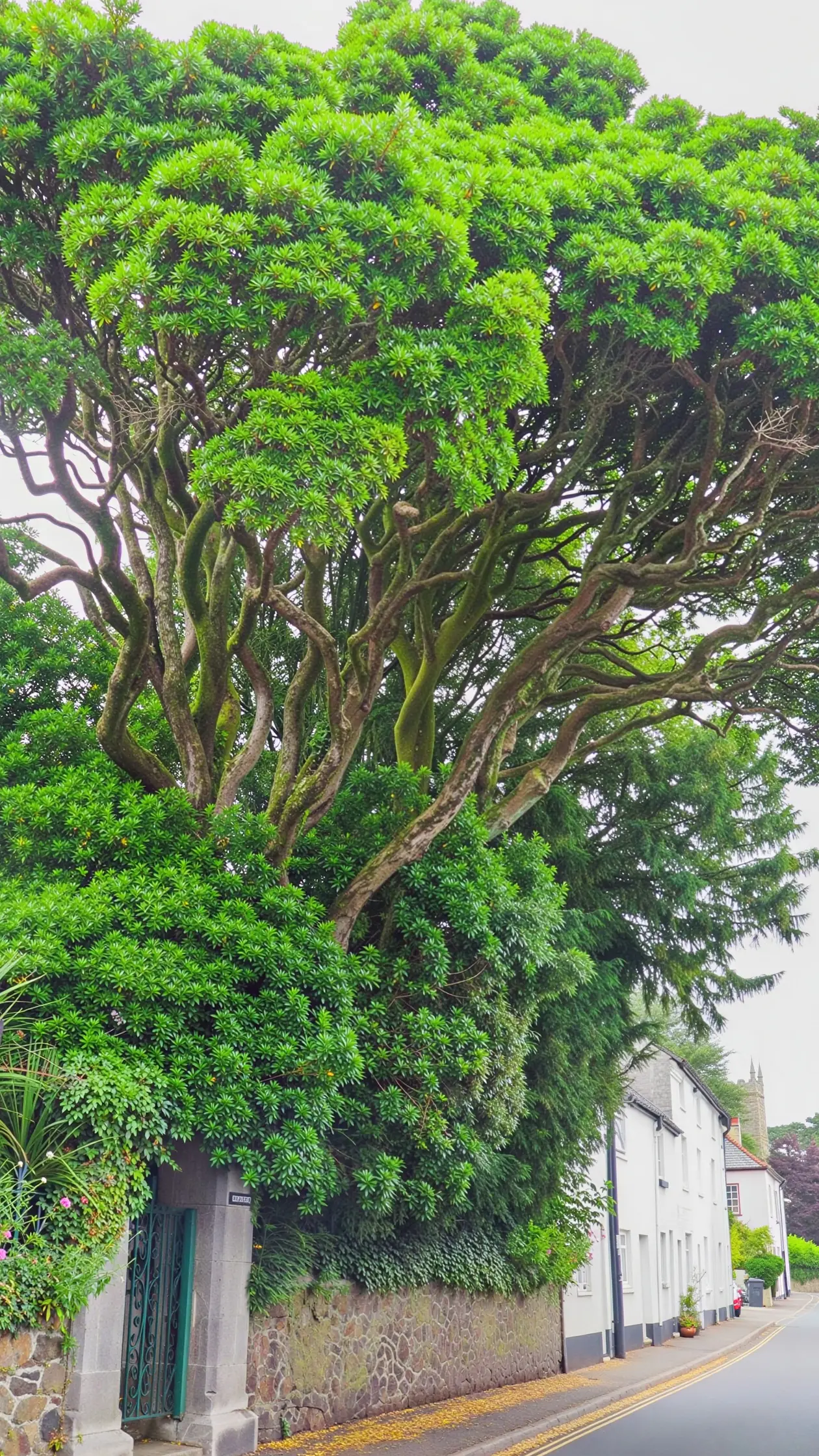
“Among the winners of climate change will be the easy-going ones, resistant to heat and drought, and undemanding when it comes to soil. The strawberry tree, Arbutus unedo, is on the list, set to spread northwards as winters grow milder, particularly along our entire coastline. In truth, this champion is not on its first migration: its strictly Mediterranean distribution is marred by an intriguing presence in Ireland, so long-established that it passes for native there — local, basically! It was long thought, moreover, that there was an Irish strawberry tree different from ours, a survivor of the ice ages, or even one that had arrived by migration (natural or assisted)…”

Organic urbanism is neither biomimicry nor a new functionalism painted green

For centuries, we knew how to welcome nature into the city organically, without trying to turn it into a system or make a fuss about it: we planted a tree for its shade, a vine for its fruit, a hedge to enclose a garden. The modern era broke with this obvious practice in two opposite ways.

On the one hand, there is an attempt to imitate nature. So-called organic architecture, and later biomimicry, seek to cover cities with forms that evoke living things: undulating or deconstructed façades, rounded balconies, forest towers. But a building shaped like a tree is not a tree. These images reassure the eye without feeding a single insect or cooling a street: they provide the scenery of nature, rarely nature itself.
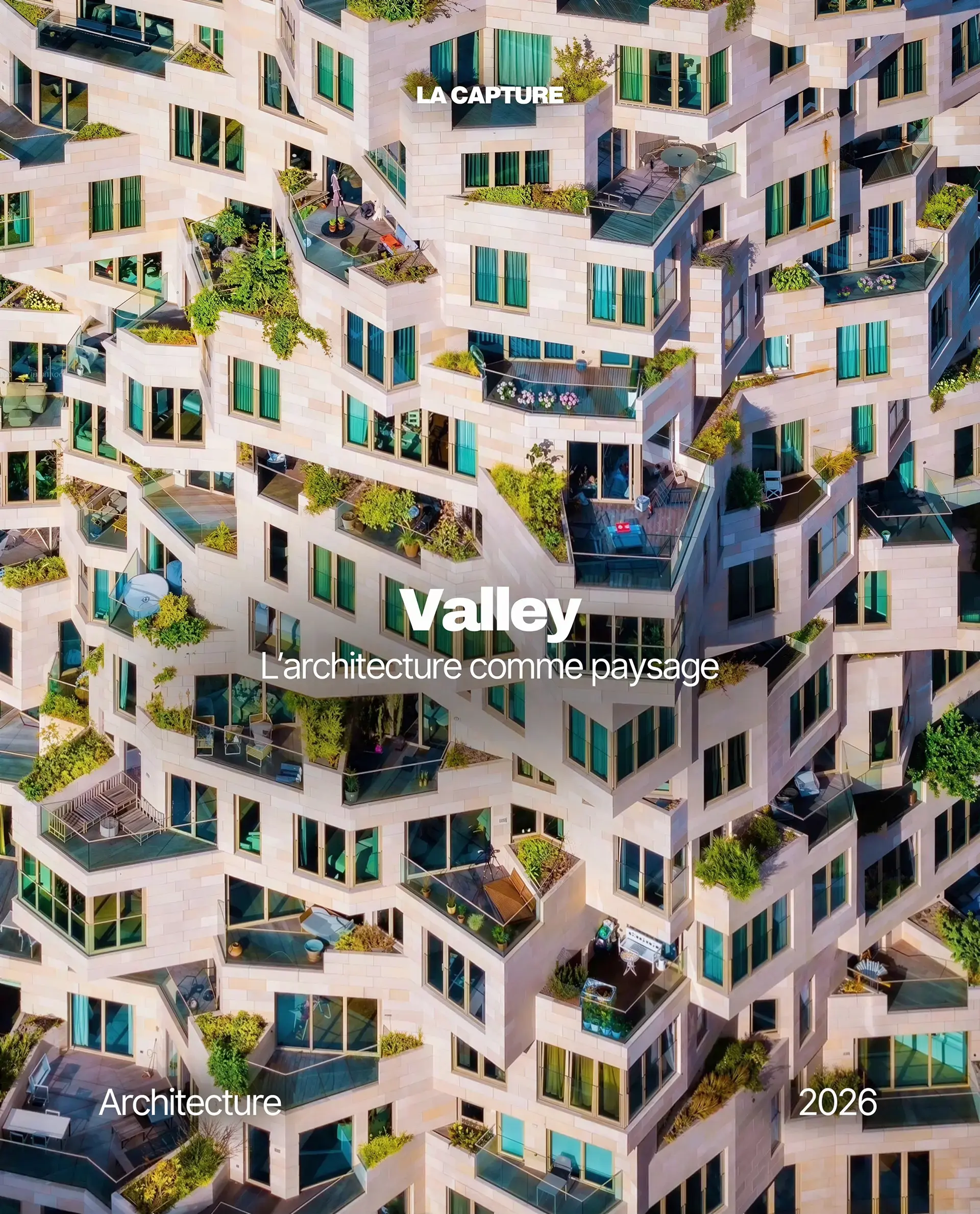
We absolutely want to control everything, down to every detail, but at the same time we are becoming ever more nostalgic for what this control stifles… life. So we try to bring it back by mimicking it: we break up lines that are too straight, we offset volumes, we suspend terraces in mid-air. We let a little greenery trickle down the façades, as if to let something unruly and organic, something that might have escaped the plan, reappear there. But what we have before our eyes is not life. It is nostalgia for it, frozen in a simulacrum.

On the other hand, there is an attempt to instrumentalise nature. Nature has become a matter of figures serving a function: open-ground ratio, percentage of planted surface, number of trees planted… and air-conditioner equivalents. We quantify, we measure, we define a theoretical usefulness that says nothing about our real capacity to welcome nature and help it thrive in our cities.
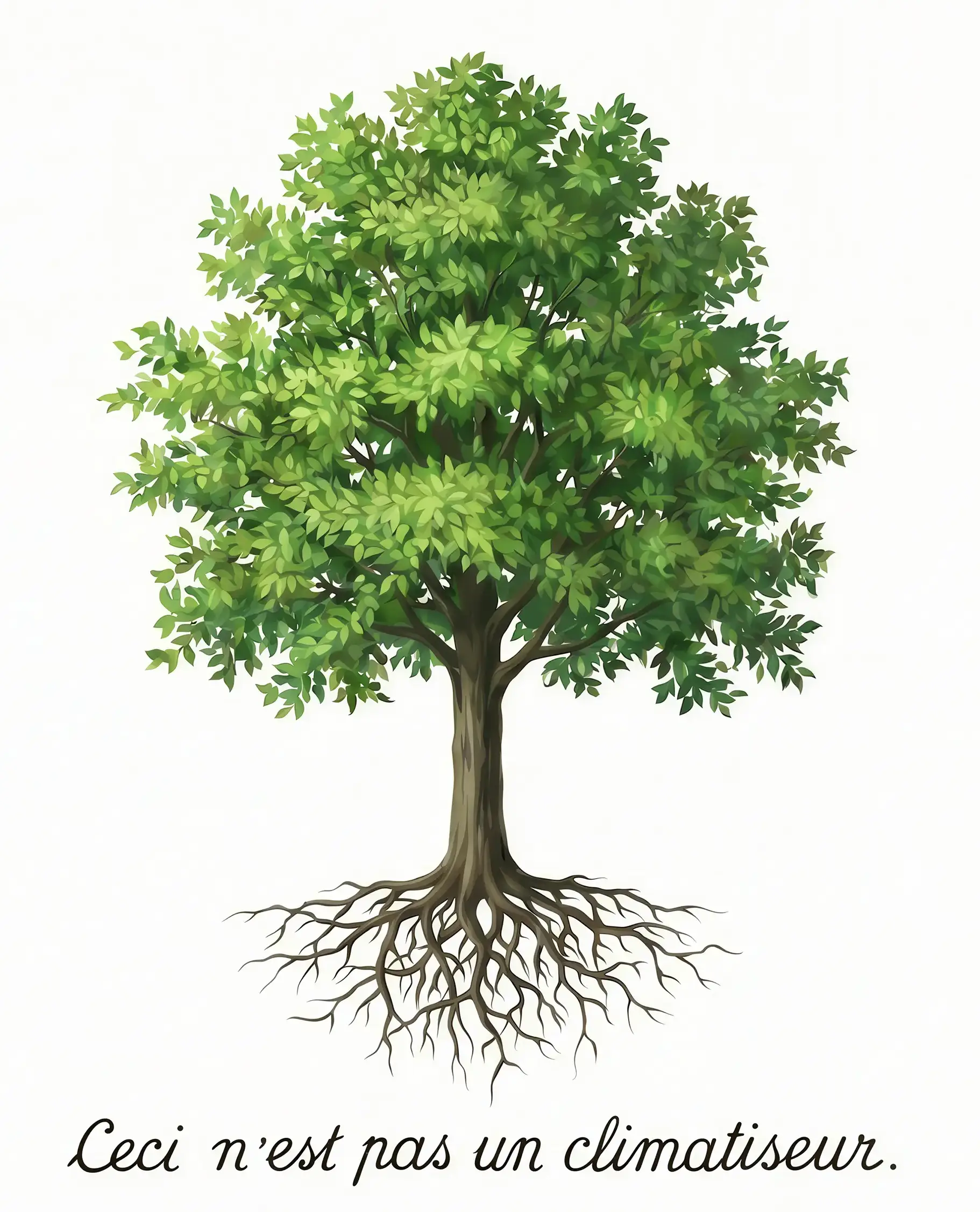
Its cooling power is real, but conditional, fragile, and too often overestimated in public discourse. By dint of idealising it, we forget its concrete needs: the space and care it must be given so that it can fully play its role.

Imitating nature, or counting it: in both cases, this means treating it as a finished product, as a form to be reproduced, as a simple device.

Organic urbanism offers a third way. Making the city with nature does not mean drawing forms that resemble it, or lining up figures that measure its performance: it means creating and maintaining the conditions that keep it alive, and entrusting that care to as many people as possible.
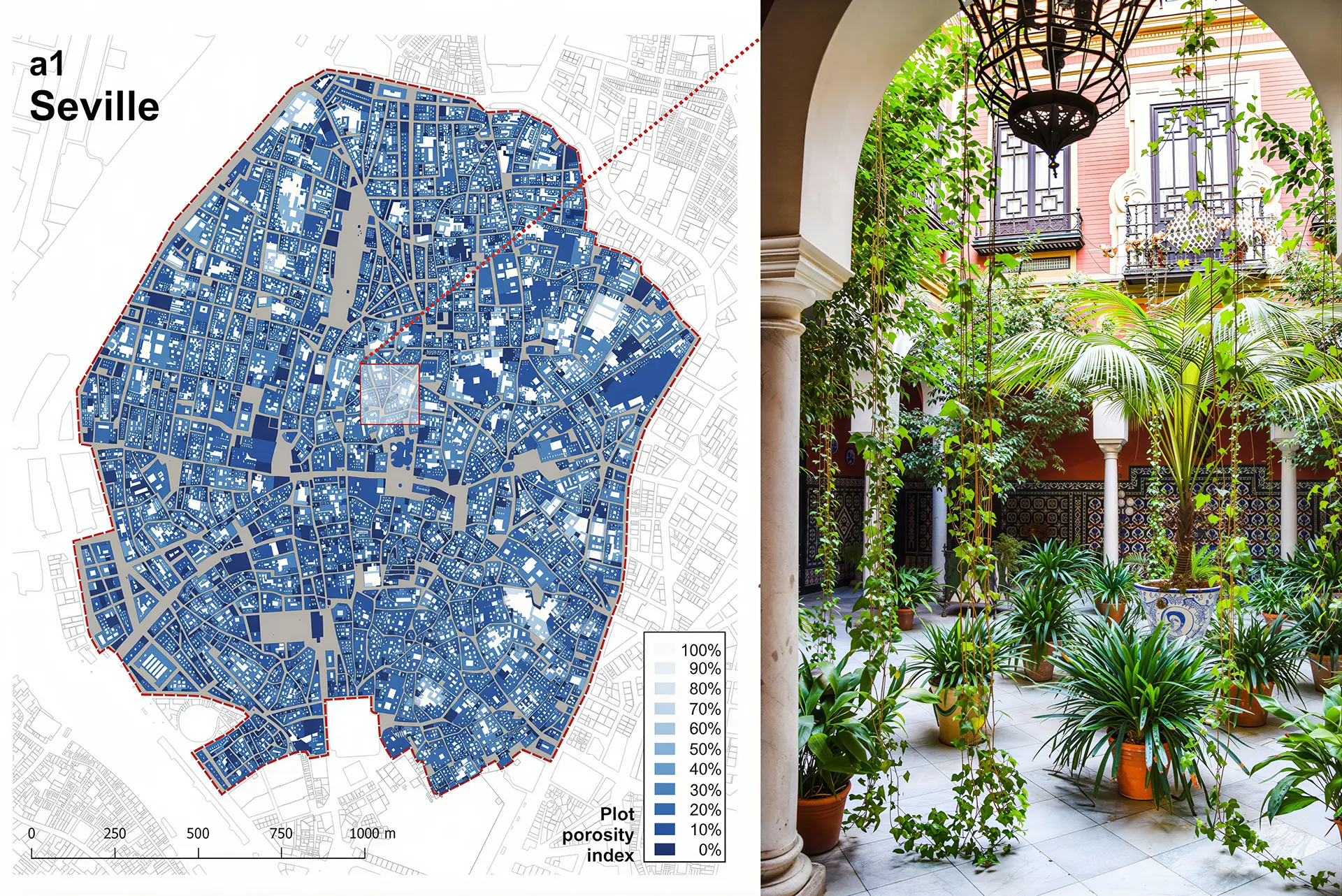
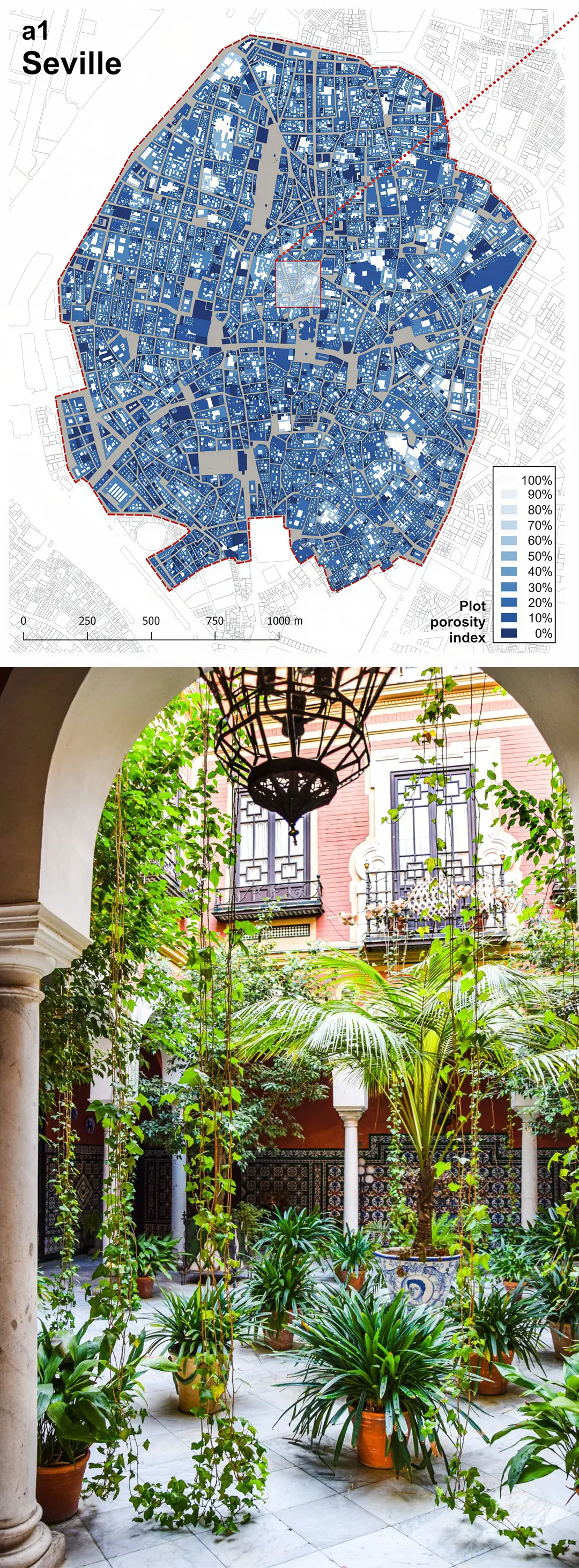
Research carried out at the University of Seville (Carmen Galán-Marín et al., 2020–2023) shows that Andalusian patios lower indoor temperatures by 6.8 to 14.3 °C during episodes of extreme heat. A passive device of exceptional efficiency, and yet still very poorly predicted by our digital models. The patio was not designed on the basis of a calculation. It was not invented by a designer for a particular project. It was (literally) discovered long before microclimatology came into being. It is the fruit of a long and patient process of distributed R&D, based on thousands of in situ tests: observing what works, adjusting what fails, passing on what stands the test of time.

The art of holding opposites together

We have been taught to choose: the city or nature, buildings or living things, densification or greening. These are false alternatives, and they cost us dearly in everyday life: by constantly setting the two against each other, we can no longer densify, that is, build where we should in order to spare nature, nor welcome people where we nevertheless need fresh hands to garden.

The result: urban sprawl continues, and the housing crisis is deepening.

Grouping housing and activities together spatially makes it possible to spare habitats outside urban areas. The combined greening and densification of the urban fabric make it possible to organise coexistence: the wall shelters the plant; the plant protects the wall. Built shade protects the tree as much as the passer-by. And it is indeed the same act (dividing a plot, building a home on it) that adds one more resident and one more gardener to the city.

Sparing and sharing. Building and planting. Densifying and gardening. Constructing, dwelling and maintaining, one plot after another.

Learn more

Services

✼ With the VVPLACE teams: model more finely the ecological dynamics under way in your area — soils, canopy, ecological networks, garden mosaics — discover new levers for making room for more nature without spreading the city, then carry out pre-operational studies in order to set up operations that combine gentle densification with the strengthening of biodiversity.

✼ With the VVPLUS teams: launch gentle densification operations that make residents the gardeners of the living city, to house more people, better, at affordable prices, without taking up new natural and agricultural land.

✼ With the VVCAMP app: give everyone, expert or not, the means to explore the links between plants and insects, to get to know and choose the right species and make their garden a link in the chain of urban biodiversity.

Training

MBA Urbanisme Organique: in September 2026, Sciences Po Rennes and Villes Vivantes are launching an Executive MBA to understand how areas are shaped where top-down and bottom-up approaches meet: 120 hours of training, between Paris and Rennes, and two study trips.

VVSCHOOL: the school of organic urbanism. Discover our short remote courses, at lunchtime or in the evening, and put together a bespoke programme to help your teams change their mindset.

ORGANIC CITIES: discover organic urbanism as it is conceived and practised on every continent. Access the proceedings and replays of more than 150 talks given at the international conferences held in Paris (2024) and Rennes (2025), and discover the programme for the next edition in 2027.

VVGUIDE: The Villes Vivantes guide, with contributions from 46 urban experts. Explore the range of possibilities and discover new, concrete options to adapt and transform areas, with and for their residents.

✼ Book an appointment with Thomas Hanss to discuss the opportunity of launching a series of talks in your area, within your organisation, to change gear and step up a level.

Examples of ongoing operations

✼ In Clermont-Ferrand, the BAMBA operation led by Villes Vivantes treats planting as part of the architectural project, not as a finishing touch added afterwards: each plot is sold with its fences, its planting and landscape design support already included in the price, and the choices involved — species, thermal comfort both indoors and outdoors, uses of the garden — are made with the future gardener rather than for them.

✼ Mettre l'intensification urbaine au service des transitions d'Aix-Marseille-Provence [Putting urban intensification to work for the transitions of Aix-Marseille-Provence]: led jointly by Villes Vivantes, the OFCE (a French economic research centre attached to Sciences Po) and the Métropole Aix-Marseille-Provence, this research aims to model and build scenarios for changes in built density and density of use across the metropolitan area, in order to measure whether urban intensification can actually be put to work for ecological transitions rather than stand in their way.

✼ TRAME DE FRAÎCHEUR [COOLING NETWORK] — Densifier et végétaliser pour rafraîchir la ville [Densifying and greening to cool the city]: carried out with Vichy Communauté and the partners VERDI and Scity, this action research project models how the gentle densification of private plots can, paradoxically, strengthen urban vegetation cover rather than reduce it — by supporting owners towards gardens that are denser in biodiversity, richer in vegetation layers, and that contribute to a cooling network at city scale.

✼ LIFE REHOME (Reuse and Enable Housing Opportunities through Municipal Experimentation): in La Rochelle, Villes Vivantes is carrying out two densifications in parallel, independently of each other or together — that of buildings, using the BIMBY and BUNTI methods, and that of the living world, in gardens — with the goals of 60 new homes and 60 enhanced gardens, to address the challenges of climate comfort and the strengthening of urban biodiversity.

Key concepts

Land sparing: densifying to spare soils

✼ La densification pour sauver les sols [Densification to save soils].

✼ Préserver les sols en ville, c'est délocaliser la destruction des sols là où ils comptent vraiment [Preserving soils in the city means relocating soil destruction to where soils really matter].

✼ Cleveland: 1 400 hectares rendus à la nature. Combien de perdus ailleurs? [Cleveland: 1,400 hectares returned to nature. How many lost elsewhere?]

Land sharing: sharing the urban fabric with living things

✼ La densification peut-elle être un levier pour améliorer la biodiversité? [Can densification be a lever for improving biodiversity?]

✼ Biodiversité en ville: le jardinier compte plus que la taille du jardin! [Biodiversity in the city: the gardener matters more than the size of the garden!]

✼ Biodiversité urbaine: rénover mieux commence par regarder mieux [Urban biodiversity: renovating better starts with looking better].

Plot division and the edge effect

✼ Division parcellaire, multiplication du soin: le paradoxe qui change tout [Plot division, multiplication of care: the paradox that changes everything].

✼ Densification douce: l'antidote au désert vert pavillonnaire [Gentle densification: the antidote to the green desert of single-family neighbourhoods].

✼ Jardins familiaux & jardins privés: comment la division parcellaire démocratise l'accès au potager [Allotments & private gardens: how plot division democratises access to vegetable gardening].

Habitat mosaics and environmental heterogeneity

✼ La diversité cultivée nourrit la diversité sauvage [Cultivated diversity feeds wild diversity].

✼ Quand le bitume confirme la règle: pas de biodiversité sans hétérogénéité des milieux [When tarmac proves the rule: no biodiversity without environmental heterogeneity].

✼ Le rôle inattendu des micro-jardins privés de Paris pour la préservation d'une espèce protégée [The unexpected role of Paris's private micro-gardens in preserving a protected species].

Ecological networks and corridors

✼ Derrière chaque plante au jardin, un réseau vivant à révéler [Behind every plant in the garden, a living network to reveal].

✼ La densification douce peut activer le maillage vert que l'urbanisme écosystémique appelle de ses vœux [Gentle densification can activate the green network that ecosystem-based urbanism calls for].

Multiplication, diversification and aggregation effects

✼ Pourquoi nous devons être plus nombreux à jardiner? [Why do more of us need to garden?]

✼ Le moteur sous-estimé de la biodiversité urbaine: la diversité des habitants [The underestimated driver of urban biodiversity: the diversity of residents].

Novel ecosystems: the ecosystems the city invents

✼ Ce que la ville invente: des écosystèmes sans précédent dans l'histoire du vivant [What the city invents: ecosystems unprecedented in the history of life].

✼ D'ici 70 ans, plus de la moitié des écosystèmes terrestres n'auront plus d'équivalent historique [Within 70 years, more than half of terrestrial ecosystems will no longer have a historical equivalent].

✼ Entre le mur et la plante grimpante, tout un écosystème à portée de main [Between the wall and the climbing plant, a whole ecosystem within reach].

Natura naturans VS natura naturata

✼ On ne sait plus produire de villes vivantes, alors on en fabrique des imitations [We no longer know how to produce villes vivantes, so we manufacture imitations of them].

✼ Faut-il figer le tissu urbain au nom du vivant? [Should the urban fabric be frozen in the name of the living world?]

✼ Le grand livre des villes vivantes: comprendre les processus qui engendrent la ville [The great book of villes vivantes: understanding the processes that give rise to the city].

✼ Baruch Spinoza, Ethics (1677), Part I, Proposition 29, Scholium.

Maintenance, management practices and ecosystem dynamics

✼ L'arbre (et le paysagiste) qui cache la pelouse [The tree (and the landscape architect) that hides the lawn].

✼ +12% en un an: ce que le boom du gazon synthétique dit (vraiment) de nos jardins [+12% in one year: what the artificial grass boom (really) says about our gardens].

✼ Plus le jardin est grand, moins il produit: le paradoxe de la surface [The bigger the garden, the less it produces: the paradox of size].

✼ Transformer un petit jardin urbain de 200 m² en havre de biodiversité: l'histoire d'une reconquête écologique [Turning a small 200 m² urban garden into a biodiversity haven: the story of an ecological recovery].

Human–nature coupling and health

✼ Avoir un jardin ne devrait pas être réservé aux plus aisés [Having a garden should not be reserved for the well-off].

← ORGANIC URBANISM (1)
ORGANIC URBANISM (2) →