BUNTI
Transforming buildings
BUNTI: weaving the city of tomorrow into the buildings of today
BUNTI—which means “to weave” in Hindi, but also evokes kindness through the Anglo-Norman “bontë”—is an urban planning approach that consists of transforming, reconfiguring, and renovating existing buildings to adapt them to contemporary housing demand. A method developed and tested since 2018 by Villes Vivantes, as open source, as a natural complement to BIMBY.
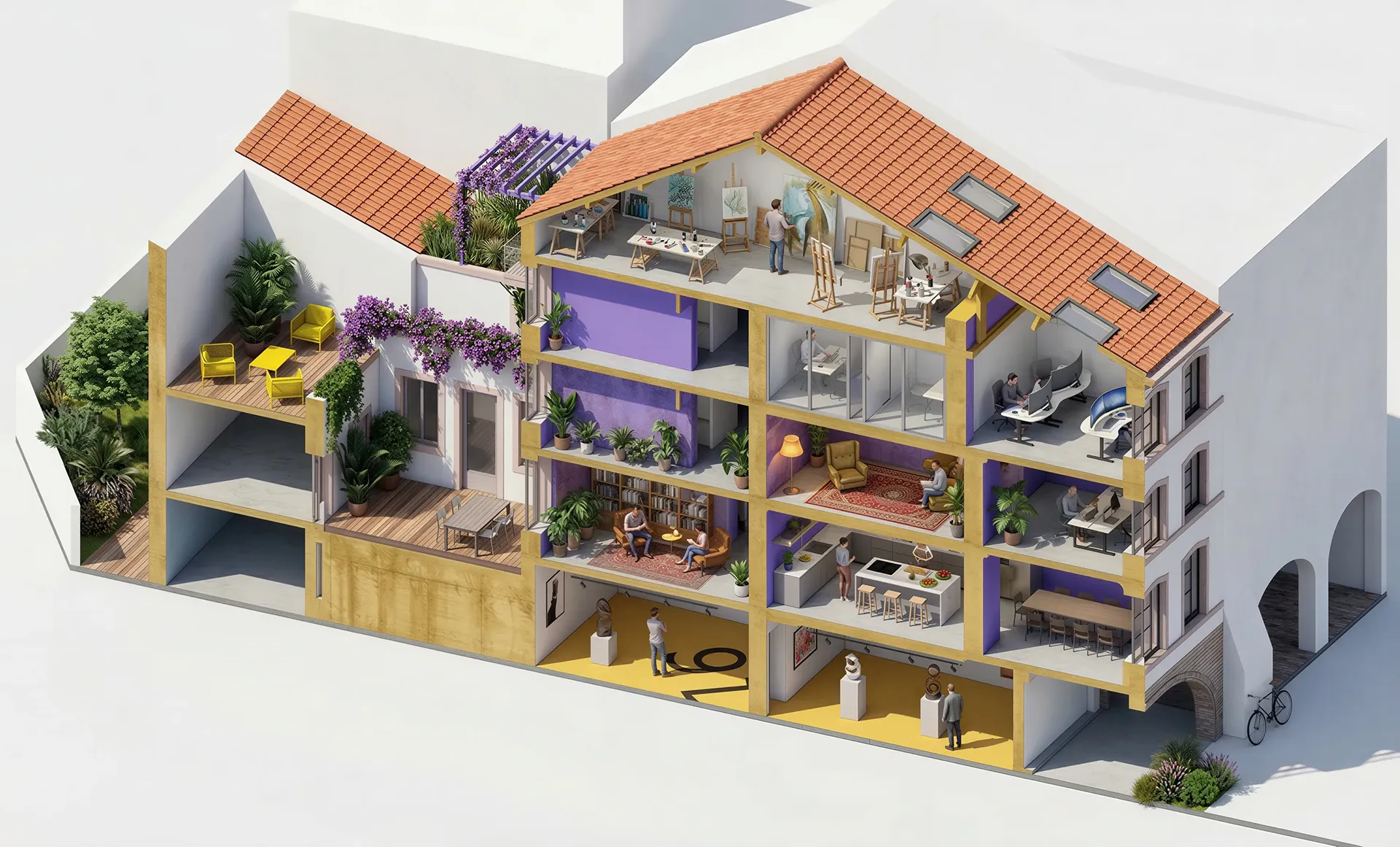
The principle: thousands of buildings—detached houses, town-centre apartment buildings, old barns, vacant homes—were designed in another era, for other ways of life. They no longer meet today's needs: too dark, poorly laid out, lacking outdoor space, unsuited to ageing or to family life, and often poorly insulated. BUNTI consists of transforming them from the inside, with their owners, to make them desirable, liveable, and full of life once again. But also of extending them, adding upward extensions, and subdividing them to create new homes.
BUNTI is more than just a simple energy renovation: it is a comprehensive, tailor-made project engineering approach that rethinks the layout of spaces, brings in light, opens up to the outdoors, and generates new homes through projects driven by residents and the millions of small-scale owners who wish to adapt their property and increase its value.
Transforming existing buildings, not just renovating them
Energy renovation is necessary, but it is not always enough. For many homes—particularly in town and village centres—it is not insulation or a new boiler that will make people want to move in: it is their complete reconfiguration.
A dark apartment that can be brought into the light by opening up a courtyard, a house on several levels that can be reorganised into a single-level home for one's later years, a vacant building that can be transformed into several homes with private terraces, a barn that can be converted into a dream house: this is BUNTI territory.
BUNTI does not seek to replace existing buildings: it seeks to reveal them and unlock their potential. It is the art of working with what already exists, carefully adapting it to today's needs. And as with BIMBY, it is the local authority that creates the conditions for this to happen, by organising a tailor-made support service for its residents.
The main types of BUNTI projects
A BUNTI project can take a wide variety of forms, depending on the building, its owner, and their needs:
✼ Reorganising a house to create a single-level, age-friendly home at ground level, and renting out or selling a family-sized upper floor with independent access;
✼ Extending a building or adding an upward extension to create new homes or enlarge the existing one;
✼ Transforming a town-centre building to recreate private outdoor spaces—terraces, balconies, patios—which are essential for attracting families;
✼ Bringing vacant or run-down homes back into use, making them desirable again through extensive reconfiguration;
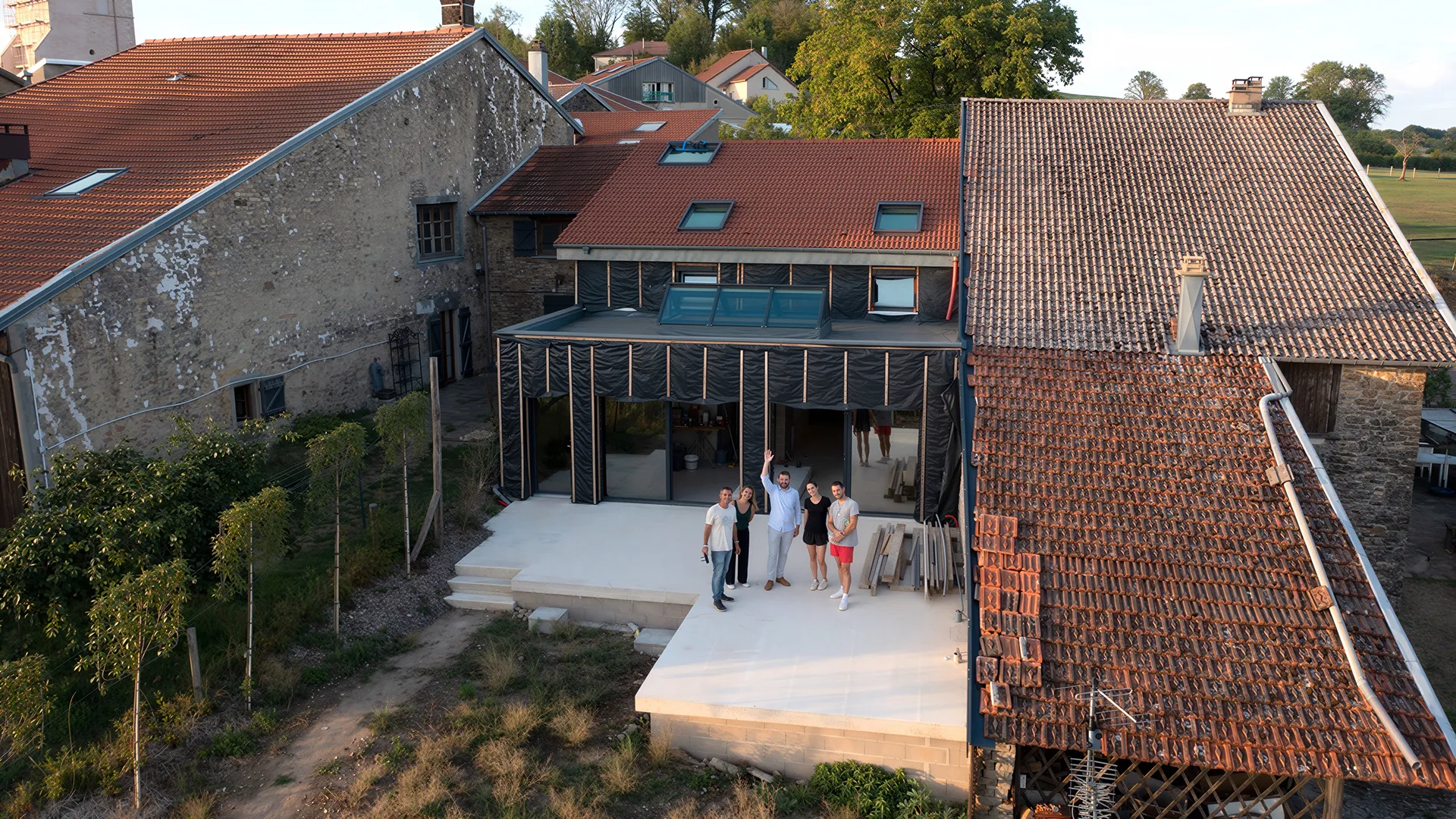
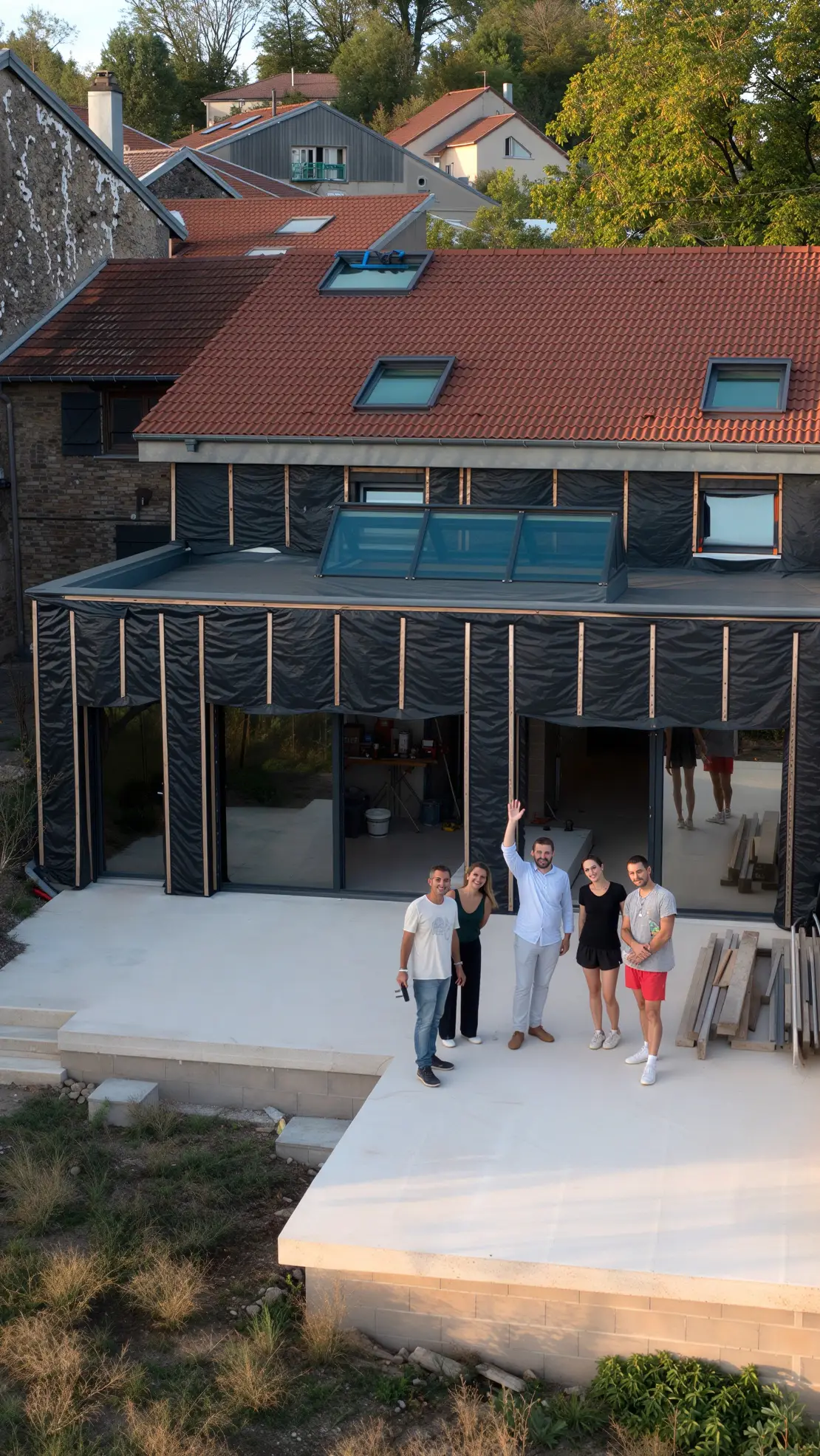
✼ Converting a barn, a shop, or an outbuilding into a liveable home;
✼ Subdividing a large home into several units suited to smaller households;
✼ Ambitious energy renovation integrated into a comprehensive reconfiguration project.
What gives BUNTI its strength is precisely this diversity: each project is unique, tailor-made for a building, an owner, a neighbourhood. No catalogue, no prefabricated solutions: only rigorous engineering, combined with a capacity for holistic design in the service of each resident's life plans.
BUNTI and BIMBY: two inseparable approaches
BUNTI and BIMBY were born together, in the field, in Périgueux. It was while supporting owners as part of a BIMBY operation that the Villes Vivantes team discovered that many project owners were not looking to build something new in their garden: they wanted to transform their existing house, bring a vacant building back into use, or reconfigure an apartment building. BUNTI was born from this reality on the ground.
The distinction between the two is simple:
✼ BIMBY = creating a new, independent building on an already developed plot.
✼ BUNTI = transforming the existing building itself: extension, upward extension, interior reconfiguration, renovation, change of use.
In practice, the two approaches are inseparable. For every resident they meet, the adviser explores all the options—building new, transforming the existing structure, or combining the two—and it is the owner who chooses, based on their needs, their means, and their life plans. Very often, it is the sale of part of the land (BIMBY) that finances the ambitious transformation of the existing house (BUNTI); or conversely, it is the reconfiguration of the building (BUNTI) that frees up the budget for a new home in the garden (BIMBY).
Beyond the help desk: on-demand co-design
BUNTI is based on a conviction: public renovation assistance schemes will not, on their own, trigger the transformation of the older building stock. Before applying for a grant, you need to have a project idea. And to have a project idea, you need support.
BUNTI engineering is an on-demand co-design service, funded by the local authority: a highly qualified adviser meets the owner at home, explores the potential of their property, and models several viable scenarios for its evolution with them. No commitment, no administrative formalities. The project owner is then free to choose to carry out one of these scenarios, drawing on existing grants and relying on local professionals.
This support covers every dimension of a project:
✼ Architectural: layout of spaces, natural lighting, creation of outdoor spaces, choosing the right property strategy;
✼ Technical: structural feasibility, energy performance, bioclimatic design;
✼ Regulatory: land-use law, relations with the ABF (the French State’s heritage architects), planning approvals;
✼ Financial: costs, access to credit, available grants (Anah [the French national housing agency], MaPrimeRénov', etc.), financial balance of the project;
✼ Family: alignment between joint owners, mediation, support in decision-making;
✼ Relational: obtaining neighbours' consent, managing impacts on the neighbourhood.
It is this holistic vision that distinguishes BUNTI from simple renovation advice: the adviser is not a specialised technician responding to a pre-formulated request. They are a designer capable of connecting all the dimensions of a project, raising its ambition, and helping the owner make decisions that are good both for them and for their neighbourhood.
A double-digit leverage effect for public investment
The BUNTI economic model is based on the principle of leverage: for every euro invested by the local authority in support engineering, ten euros—and often much more—are invested by owners in transforming their property. The local authority does not fund (or does not only fund) the works: it funds the intelligence that makes it possible to trigger them.
This model is compatible and can be combined with all existing assistance schemes: MaPrimeRénov', Anah schemes, OPAH-RU (a French urban housing improvement programme), ORT (a French town-centre regeneration scheme), territorial PACTES. BUNTI does not replace these schemes: it complements them, activates them, and multiplies their effects tenfold, by providing project engineering that owners cannot find anywhere else.
How does a BUNTI operation work?
A BUNTI operation (very often launched in conjunction with BIMBY) is structured into several phases:
✼ Area diagnosis: identifying priority areas, analysing the condition of buildings, locating vacant homes, run-down buildings, and transformation potential; defining a strategy tailored to different neighbourhoods and coordinating the BUNTI scheme with the other private housing schemes offered by the local authority.
✼ Regulatory adjustment: adapting the local planning regulations (PLU) to remove obstacles to the transformation of existing buildings, defining qualitative guidelines on outdoor spaces, light, and façades, defining an operational scope, and quantifying a budget as well as targets for adaptation, renovation, transformation, and the production of new housing supply.
✼ Resident engagement: communication campaigns, a website for booking appointments, local intermediaries—to also reach owners who do not yet have a project idea in mind.
✼ Tailor-made co-design: an individual meeting with each project owner, modelling of several evolution scenarios, and an architectural, technical, financial, and regulatory feasibility study. All BIMBY and BUNTI options are explored together.
✼ Support through to completion: individualised follow-up of the project owner, from co-design to the end of construction, including the building permit and putting them in touch with local professionals.
✼ Monitoring and evaluation: measuring results (projects designed, authorised, delivered) and continuously adjusting the strategy.
Homes reawakened, residents reconnected with their neighbourhood
Since 2017, Villes Vivantes has led BUNTI operations in dozens of French local authorities. In total, several hundred housing projects have been designed, supported, and transformed: properties reconfigured, made liveable and desirable once again.
In Périgueux, half of the 250 homes authorised over five years were part of BUNTI projects: reorganised houses, homes brought into the light, buildings brought back into use. In Épinal, a building that had been vacant for fifteen years, considered impossible to make use of, was transformed into four bright homes with terraces. In Morlaix, a BIMBY-BUNTI operation gave rise to 600 housing projects in eighteen months. In Nancy, the BUNTI operation is being deployed in the city centre to bring back to life the upper floors of buildings whose street-level units are active retail spaces.
Renovated, integrated, living urban forms
Because they fit into the existing fabric and respect the scale and atmosphere of each street, each village, or each housing development, BUNTI projects are often imperceptible once completed: they enrich neighbourhoods and landscapes without distorting them. Each project is a discreet but real contribution to the quality of the shared living environment.
Tackling vacancy: reawakening dormant homes
France has nearly three million vacant homes. For many of them, vacancy is not due to a pricing problem: it is the configuration of the home that no longer matches demand. Too dark, poorly laid out, lacking outdoor space, it does not inspire anyone. Energy renovation alone will not make it desirable.
BUNTI is specifically designed for these situations: by offering a complete reconfiguration—light, outdoor spaces, layout, access—it can turn an unsellable home into a desirable one. And in doing so, contribute to the revitalisation of town and village centres.
Adapting to ageing: staying at home, differently
France is ageing. In the coming years, millions of owners will find themselves in houses poorly suited to their age: too large, spread over too many levels, too difficult to maintain. BUNTI offers an alternative to a care home or a forced move: reconfiguring one's house to live in it differently (a bedroom and shower room at ground level), adapting the space to one's current needs, and often financing these works by renting out or selling the part that has become surplus.
Revitalising centres: attracting families where homes no longer inspire
Many town and village centres are seeing their homes empty out, not for lack of demand, but for lack of appeal: families prefer to settle on the outskirts, where they find bright houses with gardens. BUNTI can reverse this logic by giving town-centre homes what would make them desirable: light, outdoor spaces, suitable layouts. It is not the size of the home that matters: it is its quality of life.
No net land take: transforming rather than sprawling
BUNTI is the no net land take tool par excellence: it produces housing without consuming a single new plot. It taps into the considerable resource represented by the existing building stock—underused, poorly configured, or vacant buildings—to meet housing needs without sprawl. And it does so with a financial and ecological footprint far lower than that of new construction.
Affordable housing: a short supply chain, driven by residents
BUNTI projects are driven by private individuals, through owner-led development. Production costs are often lower than those of new-build property development, because the chain is short: the owner, supported by the BUNTI engineering made available by the local authority, then contracts directly with local professionals (architect, builder, craftspeople) to carry out their projects. This short supply chain works even in low-pressure property markets, where developers and land developers can no longer operate.
BUNTI and the complementary methods of Villes Vivantes
BUNTI is part of a set of four complementary methods developed by Villes Vivantes to implement organic urbanism in local areas:
✼ BIMBY (Build In My Back Yard): constructing a new, independent building on an already developed plot—a house, a studio, a small office—via plot division or backyard development.
✼ BUNTI: transforming the existing building itself—extension, upward extension, interior reconfiguration, renovation, adaptation to contemporary demand.
✼ BAMBA: supporting owner-led housing development dynamics in structured operations, by reinventing dense custom-build plots and custom-built detached houses.
✼ BRAMBLE: strategic intensification operations based on a multitude of small, high-density projects, which may include replacing an existing building. In practice, BIMBY and BUNTI are very often deployed together, as part of the same support service offered to local authorities. All four approaches have been tested and validated in numerous French local authorities.
Learn more
Launch a BIMBY BUNTI project in my area
✼ Book an appointment with Thomas Hanss, one of the national experts in BIMBY and BUNTI projects, to discuss the opportunity of launching a project in your area.
✼ With the VVPLACE teams: conducting a pre-operational study to assess potential and define the goals and scope of a project.
✼ With the VVPLUS teams: managing and leading a project to create 50, 100, 200, or 300 additional housing units without urban sprawl over 5 years.
Examples of ongoing projects
✼ The BUNTI project of the city of Nancy. ↗
✼ The BIMBY BUNTI project of Aurillac Agglo. ↗
✼ The BIMBY BUNTI project of Morlaix Communauté. ↗
✼ The BIMBY BUNTI project of the Pays de Ribeauvillé and the Kayserberg Valley Community of Communes. ↗
✼ The BIMBY BUNTI project of the SCoT of the Central Vosges. ↗
Case studies
✼ France 5 — Comment réaliser son rêve d’habitat dans le patrimoine bâti ancien avec le BUNTI [How to achieve your dream home in old heritage buildings with BUNTI], 2024. ↗
✼ Les opérations BUNTI: de la rénovation à la reconfiguration [BUNTI operations: from renovation to reconfiguration] ↗
✼ Comment donner envie à des familles de s’installer en centre-ville grâce au BUNTI? [How can BUNTI make families want to move to the town centre?] ↗
✼ BIMBY + BUNTI vs étalement urbain [BIMBY + BUNTI vs urban sprawl] ↗
References
✼ Caraire, D., Hernandez, A. (2024). BIMBY et BUNTI: faire des habitants les maîtres d’ouvrage de la transformation des tissus urbains et ruraux [BIMBY and BUNTI: making residents the project owners of urban and rural transformation]. Organic Cities, Paris. Sciences Po & Villes Vivantes. ↗
✼ Miet, D., et al. (2025, February). BIMBY, BUNTI: outils pour réussir la transformation des quartiers pavillonnaires en villages [BIMBY, BUNTI: tools for successfully transforming suburban neighbourhoods into villages]. Opérations Immobilières, No. 171-172, January-February 2025. ↗
✼ VVGUIDE, Le guide de la densification douce et de la mobilisation du parc bâti existant [The guide to gentle densification and mobilising the existing building stock] ↗
✼ Rénovation et reconfiguration: Bunti, une ingénierie de pointe pour multiplier par 10 l’effet de levier de l’investissement public [Renovation and reconfiguration: Bunti, cutting-edge engineering to multiply the leverage effect of public investment tenfold] ↗
✼ BUNTI: l’art de transformer et de donner de la valeur d’usage au bâti, une étape à la fois [BUNTI: the art of transforming buildings and giving them use value, one step at a time] ↗
FAQ
What is BUNTI in urban planning?
BUNTI is an urban planning approach that consists of transforming, reconfiguring, and renovating existing buildings to adapt them to contemporary housing demand. It was developed by Villes Vivantes starting in 2018, as open source, as a natural complement to BIMBY.
What is the difference between BUNTI and simple renovation?
Renovation improves the performance of an existing home—insulation, heating, renovation. BUNTI goes much further: it rethinks the layout of spaces, brings in light, opens up to the outdoors, and can generate new homes. It is a comprehensive architectural and property transformation, tailor-made for each property and each resident.
What is the difference between BUNTI and BIMBY?
BIMBY involves building a new, independent structure on an already developed plot. BUNTI involves transforming the existing building itself: extension, upward extension, reconfiguration, renovation. In practice, both approaches are very often offered together; it is the owner who chooses, after exploring all options with their adviser.
Is BUNTI compatible with renovation grants (MaPrimeRénov', Anah)?
Yes, absolutely. BUNTI engineering is compatible and can be combined with all existing assistance schemes: MaPrimeRénov', Anah schemes, OPAH-RU, ORT, PACTES. BUNTI does not replace these grants: it activates them, by helping owners design an ambitious project that justifies and fully mobilises this funding.
Does BUNTI work in all areas?
Yes. Unlike property development, which can only operate above a certain level of market prices, BUNTI works in all types of property markets: high-pressure or low-pressure, urban or rural. This is because it relies on private individuals pursuing life plans—not on operators seeking financial returns.
How can I launch a BUNTI operation in my local authority?
Implementation relies on three levers: carrying out a diagnosis of needs and of the potential for transforming buildings in the area, defining an operational scope as well as targets for adaptation, renovation, transformation, and the production of new housing supply, and then setting up a support service for residents with projects. Villes Vivantes supports local authorities at every stage, from the pre-operational study phase to monitoring completed projects.
What results can be expected from a BUNTI operation?
Results vary depending on the area and the intensity of the operation. In operations led by Villes Vivantes, several hundred projects are typically identified and supported over a period of three to five years, a significant portion of which result in completed works. In Morlaix, a BIMBY-BUNTI operation gave rise to 600 projects in eighteen months. The ratio between public investment in engineering and the private works it triggers is generally more than ten to one.