WE GROW FRANCE
Paternalism in urban planning is over: make way for freedom.
The French are free. Every individual, every family, everyone is free today to live where they wish to live.
It is no longer up to the factory boss (19th-century paternalism) or to the State (20th-century paternalism) to decide, in place of all of us, the residents, where we live.
Nor how we live.
Nor what our preferences are.
If we accept this new principle, the principle of freedom, then we can:
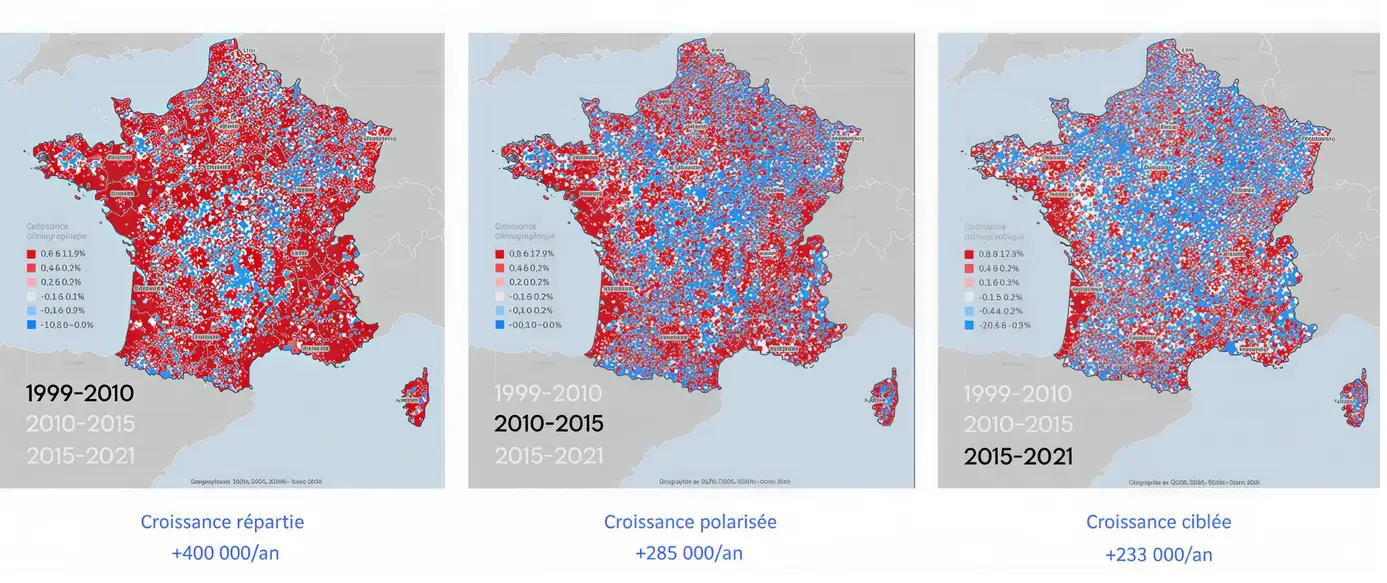
✼ better read the map of France that is reshaping itself before our eyes, and observe that it is morphing into a new configuration,
✼ understand that this configuration, precisely, is the one that will enable it to meet its 21st-century challenges,
✼ work to bring this configuration about in forms that are more robust, fairer, and more beautiful,
Nature with a capital N: how we will pursue our quest for the ideal living environment.
So many of us want, when we open our windows, to see trees and smell them: on our balconies, in our gardens, but also down in the street, in public squares, in school playgrounds, in our care homes, on the rooftops.
Everywhere, we would like to hear birdsong, to live “in a little corner of nature”. But also, within a few minutes, to be able to gaze at the peaks, the horizon, the sunset: to come into contact with Nature with a capital N, every day.
This obsession with our living environment sends us in search of the ideal location.
Very often it is the coast or the mountains that draw us. We would like to settle close by, without spoiling their purity. Without upsetting their fragile balances, without damaging these singular places with the logic of the “mass”.
If too many of us gather there, won’t we destroy the magic of these places? But conversely, if we limit the number of places, won’t we be reserving these pleasures for a privileged few?
And yet: Biarritz, La Rochelle and Saint-Malo are dense, compact, intense. On very little space, they allow thousands of French people and tourists to enjoy a fabulous living environment.
Jewels of our heritage, dating from before the era of the standardisation of the living environment, they shed light on our future: they are living proof that organic urbanism, the kind that proceeds plot by plot in a tailor-made logic, makes it possible to increase capacity to welcome people and to grow cities while making them more beautiful.
Step by step, one plot at a time.
Facing nature.
And without doing it any harm.
With the return of the tailor-made, there is no reason why new Biarritzes should not emerge wherever French people seek to gather and come together.
The City with a capital C: how we will be able to change jobs 10 times if need be.
Air France. Peugeot. La Poste. Michelin. The hospital. The national education system… Spending 40 years serving the same employer. Absolute economic security. A job for life, or almost…
We have to admit it, though: nobody is interested in this dream any more.
First of all because it no longer exists. Everyone knows that even giants can disappear in two years. We know that all the institutions likely to employ us, whether public or private, are fragile today.
And then because we have become demanding: we want to be able to change employer if our job no longer suits us.
Real economic security, today, lies in freedom: the freedom to live in a labour market area that is thick, dense and connected enough for it always to be possible to change jobs to regroup, bounce back or simply clear one’s head, if the need arises.
If, when changing jobs, we want to have the choice among ten or twenty different opportunities, and that happens 10 times in our life, then it is not one or two but a hundred or so real opportunities that we need.
This means that, if we do not want to have to move house overnight with each new professional adventure, we need to be able to live in a region whose job market is roughly a hundred times larger than the one that, in the 1960s, allowed a young technician to envisage spending his whole career at Michelin, in Clermont-Ferrand, at the foot of the volcanoes.
When it was founded, in 1889, Michelin had 50 workers, and the city 50,000 people. By 1900, 500 employees. The career for life, the company housing, the schools, the factory that looks after you “from the cradle to the grave”: all of this was built up in stages over the 20th century and peaked in the early 1980s. At its height, Michelin employed up to 30,000 people in Clermont. The city itself never exceeded 156,000 people (1975). In a century and a half, the central city has tripled, and the conurbation has grown fivefold: nearly 270,000 people today.
But doubling and growing fivefold is not growing a hundredfold.
To offer tomorrow the choice that a life in which you change jobs ten times demands, Clermont would need three or four million people. That is, almost the entire population of the Massif Central (3.8 million).
It is easier to understand why every redundancy plan there can only trigger a crisis. An area built around a single strong employer, which has never broadened or diversified its labour market, has nothing to cushion the shock. When that employer cuts its workforce (from 30,000 in the early 1980s to 14,000 in 2005), there are not enough options alongside it to allow employees to retrain.
And the story continues before our eyes. In May 2026, Michelin announced 1,500 job cuts in France over three years, nearly 9% of its workforce, after announcing at the end of 2024 the closure of its factories in Cholet and Vannes. The most “social” company in the country, the one that committed in 2024 to guaranteeing a “decent wage” to all its employees worldwide, and that has never come under the control of investment funds, has to scale back.
A household’s economic security is built today by finding its place in a City with a capital C. Yet in France, outside Paris, there is no metropolis whose urban area has 3, 4 or 5 million people. In Europe, there are cities such as Milan or Naples (~4 million), Barcelona (~6 million), St Petersburg (~7 million), Birmingham (~4 million), Lisbon, Kyiv or Manchester (~3 million people).
But Lyon and Marseille (~2 million), and even more so Lille, Bordeaux and Nantes (~1 million), remain too small to guarantee sufficient job opportunities for both members of most households whose occupations and roles are specialised.
Organic urbanism has a proposal to make to France: let us give ourselves the possibility of a second or even a third house on every plot where there is only one today, precisely in the inner suburbs of the metropolises that are too “small”, so as to enable them to welcome working people and families in a form of housing that matches their desires: a house with a garden, in a large job market. And in this way, let us transform our housing developments into villages, our dormitory suburbs into places to live, our vast car-dependent areas into places that are dense, connected and well served enough to allow an urban life that gives pride of place to walking, cycling and public transport. So that all those who aspire to simplify their daily logistics, to reduce their budget and the time spent travelling, can do so.

We can turn the public transport hubs that already serve the inner and outer suburbs of our metropolises into the future centres of larger, denser, more dynamic, more prosperous and more lively polycentric systems. We can make our emerging metropolises the places where a “French-style metropolitan and village density” is invented.
And in this way: double Bordeaux, double Nantes, double Toulouse… And their respective job markets.
From the dream of the suburban detached house and its big plot to the dream of a small garden in a real city.
What happens when a city doubles its population? Not everything doubles, because urban phenomena fall into three categories:
1/ Linear phenomena, linked to individual, biological or logistical needs: meals, water, energy consumption, waste… They increase in proportion to the population. Twice as many residents means twice as many mouths to feed.
2/ Sub-linear phenomena, linked to shareable physical infrastructure: roads, networks, pipes, built floor area… They increase more slowly than the population (economies of scale). When a city’s population doubles, its street network does not increase by 100% but by 80%.
3/ Super-linear phenomena, linked to social dynamics: wealth produced, wages, patents, interactions, crime, innovation, restaurants, cultural events, shows… They increase faster than the population. When a city’s population doubles, the wealth distributed, the patents filed, but also crimes, increase by 120%.
All this means that if we compare a town of 10,000 people with a city of one million people (100 times bigger), we will find:
✼ 100 times more household waste to collect,
✼ only 50 times more roads to maintain,
✼ but above all, what makes the magic of the big city: 200 times more restaurants, wealth created, diversity of possible jobs, cultural events, opportunities to meet people, sporting activities, etc.
These 200 times more cultural, economic and social riches are not just statistics of interest to urban planners: they are exactly the stuff that everyone’s dreams of where they live are made of.
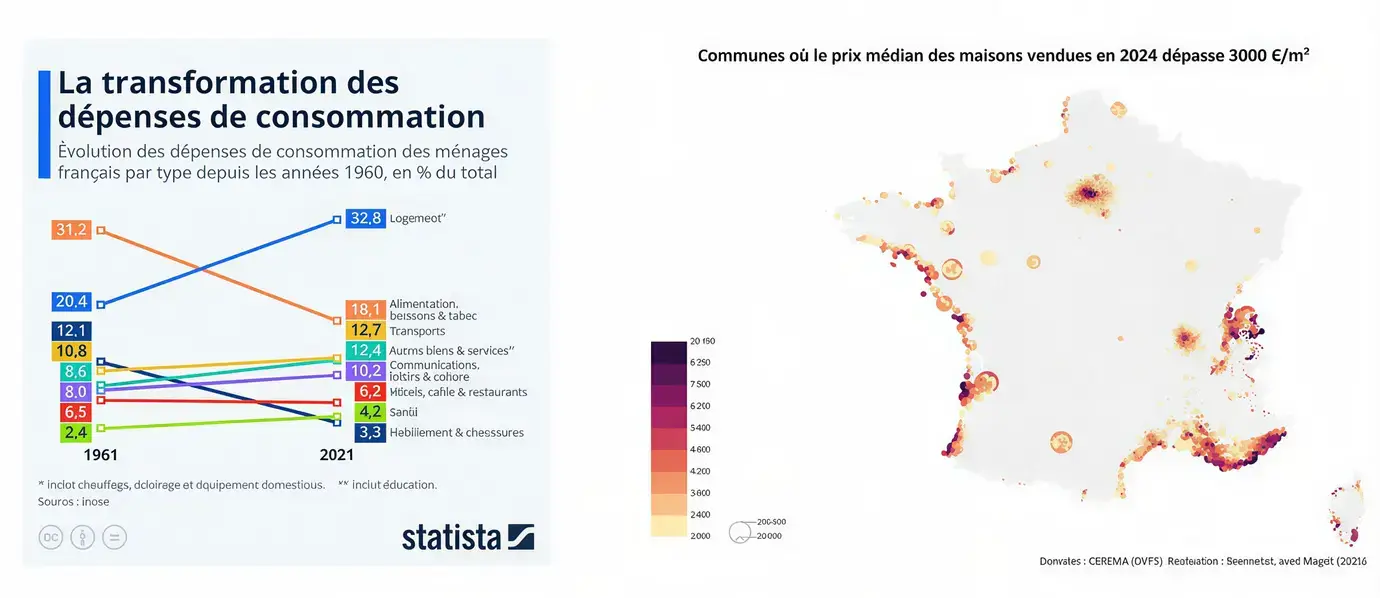
The “American” dream of the 1960s was relatively materialistic: owning a house, the household appliances that go with it, a well-stocked fridge, a garden, a swimming pool, a nice car. It depended, ultimately, on the possibility of achieving it on a plot of land connected by car to a factory or an office.
Yet we observe that this is not exactly what we find, today, spread across our Instagram accounts. But rather, the setting for all of it: what you see when you open your window, the bistro downstairs, the view over the rooftops of Paris, or over the peaks of the Pyrenees.
Whether we are doctors, teachers, plumbers, researchers or bus drivers: it is the ambience, the atmosphere, the quality and the power of places that attract us. The contemporary dream of the living environment is less material, more immaterial.
It is at once very natural (the desire to contemplate the great landscape, to come into contact with Nature with a capital N) and fundamentally artificial: economic, social and cultural, since it summons up just about everything one is likely to find in a large, dense, intense and lively city… (the City with a capital C).
Doubling Bordeaux or Nantes, by the organic method, by doubling or tripling the number of houses in their inner suburbs, by transforming our old housing developments into market towns, by bringing services, schools and shops closer to where everyone lives, thanks to density, is to bring millions of French people a little closer to this dream without forcing them, for all that, to give up the idea of living in a house and owning a garden.
The contemporary holy grail of the living environment
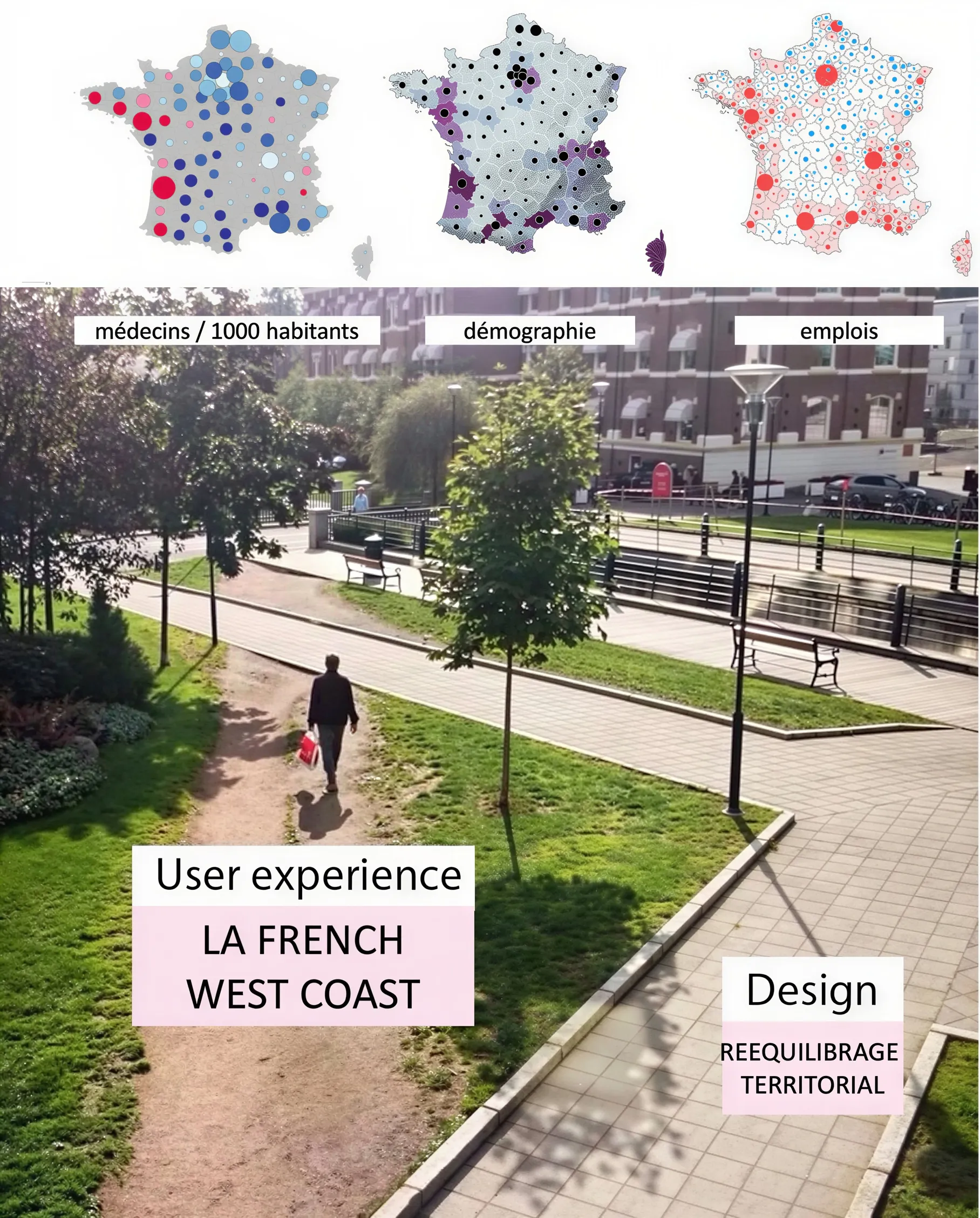
When we combine these two attractions, that of the City with a capital C and that of great Nature with a capital N, we get more or less the current map of property prices.
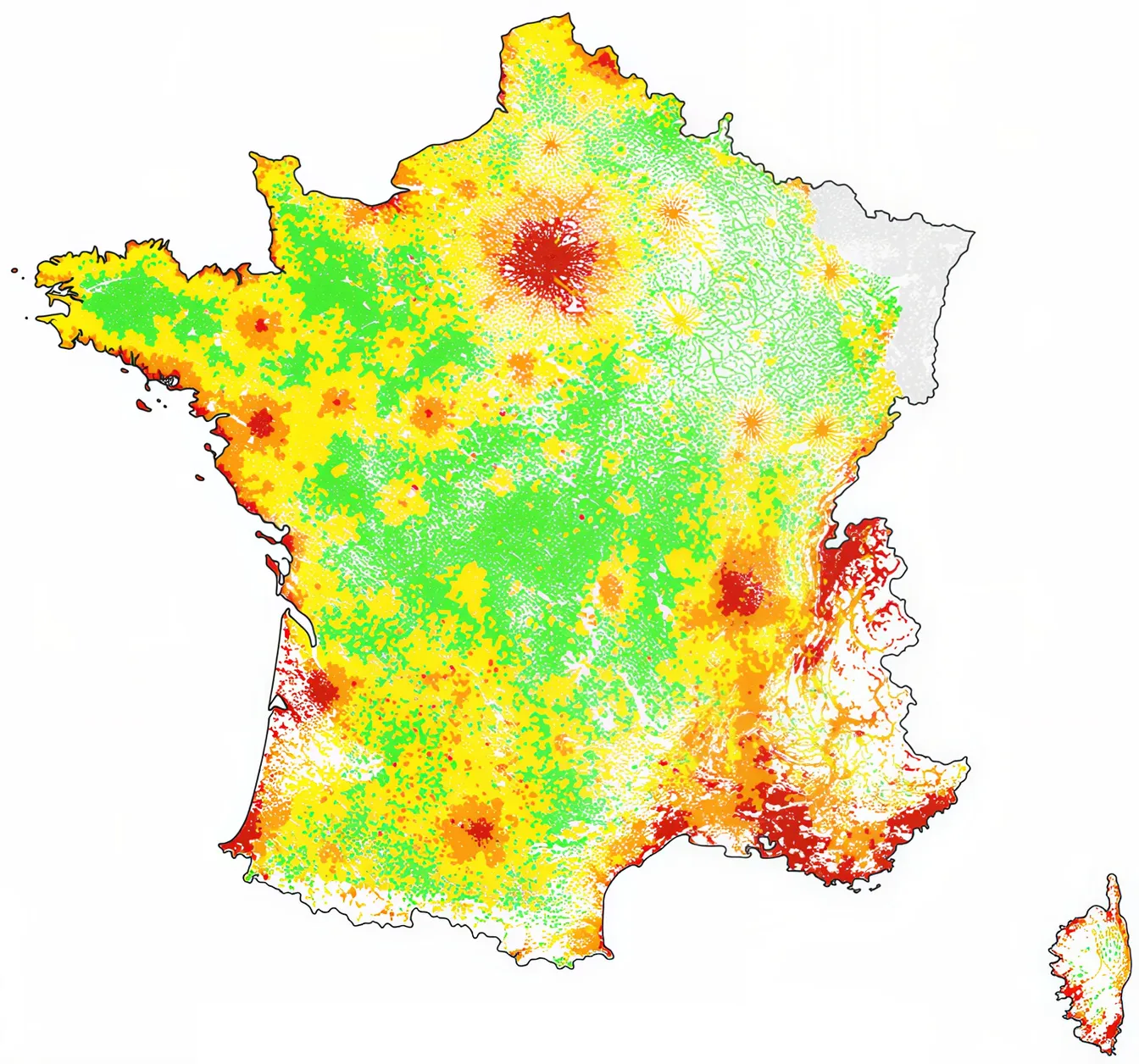
On this map, we can see a trend. And two exceptional opportunities.
The first opportunity concerns all the areas that are gradually emptying. Their population is declining, prices there are affordable, and the more time passes, the more they are filled with the calm of nature.
Admittedly, shops are closing, services are dwindling, the population is ageing. Admittedly, when it comes to work, the choice is narrowing to a few activities compatible with low-density areas.
But peace, calm, solitude, distance from crowds are also, more and more, a concrete aspiration: a few days to recharge, a few months a year, or even, for some, as an everyday living environment. Even if they are made by a minority of the population, these choices exist, they are strong, and they reflect structured, ambitious, alternative life projects. Some people do not come to the countryside looking for what they left behind in the city. Those who want to go green gradually understand what that means. The rooster, the fertiliser, the harsh winters, the medical desert, the daily miles for a baguette, are the price to pay for something that, for some, is priceless.
The second opportunity concerns the areas one might think are overheating but which are high-pressure only because they have not yet taken on the configuration in which they will be able to regain their balance: the price map shows several areas that are excellent candidates to become the most attractive places to live on the planet, in France. Places that combine the gentleness of the French art of living, large labour market areas, the City with a capital C, with access to Nature with a capital N and the potential to build thousands, millions of Houses with a capital H.
Take Bordeaux, its catchment area & the Arcachon Bay: around 1.5 million people today, one of the most attractive regional metropolises in the country… The Bordeaux opera house is only an hour from the bay and its beaches: between the two, an area with exceptional potential for welcoming people and for organic development: housing developments from the ’70s, ’80s, ’90s, 2000s… and an artificial pine forest harvested for paper pulp and construction timber. The fragile biodiversity is located on the bay itself, not in the pine forest that links Bordeaux to the bay; the vineyards are elsewhere, in the Médoc and the Entre-deux-Mers: the French San Francisco is right there before our eyes. The current 1.5 million people can become 3 million (the equivalent of half the population of Nouvelle-Aquitaine) if we loosen the regulatory lock that freezes one of the most attractive areas in France, and if we get down to work seriously, to offer affordable, well-served plots, under the pines, between the big city and the ocean. And Bordeaux could soon project an influence comparable to that of Lisbon, as a first step. If the scenario may seem frightening, let us ask ourselves: is Lisbon frightening?
If Bordeaux and Nouvelle-Aquitaine had a new role to play in France’s economic infrastructure, the capital of the South-West, and its coast, could come to compete with the Île-de-France for the location of headquarters and production sites, with an argument that is fundamental today: the quality of the living environment. That is, precisely what is driving a large number of professionals and people who have the option away from the Île-de-France.
Barcelona (5 million people in the urban area) and San Francisco (nearly 8 million) are unthinkable benchmarks today for a metropolis like Bordeaux – Arcachon only because France discovered the phenomena of metropolisation and coastal concentration only very recently. Even with an overall declining population, the Japanese example (Tokyo, 37 million people, Kyoto-Osaka-Kobe, nearly 20 million people) shows us that the spatial clustering of the population within large, dense and lively urban regions is a universal phenomenon that is transforming the geography of every continent today.
In France, of course, the Bordeaux – Arcachon Bay axis is not the only one on the list: the Nantes, Saint-Nazaire, La Baule area (1.3 million people) opens onto Vannes (0.2 million) and then Lorient (0.2 million), and more broadly the Gulf of Morbihan, with an equally extraordinary potential for attractiveness and for welcoming people.
As do Haute-Savoie, Annecy and Chambéry, which operate within the hugely powerful economic sphere of the Lake Geneva arc (nearly 3 million people from the Canton of Vaud to Annecy), in an equally exceptional living environment, just an hour from Lyon (2.3 million people) and Grenoble (0.7 million people).
Going for a swim after school, after clocking off, when it is hot, or when it is time to rest, in retirement, after a full and accomplished career. Climbing higher to find cooler air, gazing at the peaks at dusk. The Côte d’Azur (from Marseille to Nice, nearly 5 million people) also has its card to play: an immediate hinterland, the one lying less than 30 minutes from the coast, brimming with immense, highly attractive, under-exploited potential for welcoming people.
But the “coast/mountains – metropolis” paradigm is not the only configuration that allows the City and Nature to meet. The Île-de-France has, in its outer suburbs and on its fringes, bucolic areas of absolute charm: the Vexin, the Gâtinais, the Vallée de Chevreuse, the forests of Fontainebleau or Saint-Germain-en-Laye could perfectly well form the green infrastructure around which much higher urban densities could be developed, close to the backbone public transport stations (Grand Paris Express, RER, Transilien). To recover, in the inner and outer suburbs of Paris, the urban qualities, the services and local urban amenities that make for the quality of inner Paris, the capital region today lacks 2, 3 or 4 million people. Meanwhile, the potential of low-density urban fabrics able to accommodate significant gentle densification and the large-scale production of well-located townhouses with gardens is considerable.
A large part of France’s areas are going to experience decline. Just as some areas have already been experiencing it for 150 years. So as not to turn this into a tragedy, but on the contrary into an opportunity, let us not use the wrong reading grid.
Let us help those who choose life in the countryside, low-density, in peace and quiet, to do so with their eyes open. And let us not see population decline as inevitable but rather as a process like any other, one that can also set places apart and generate new qualities.
Conversely, certain strategic areas of the country can and will double, triple their capacity to welcome people. By increasing it organically, we can, here again, increase their qualities at the same time as we increase the number of places.
And this will prove decisive for the future of France.
The clustering of a large part of French people’s activity in a few strategic places is what forms the infrastructure of France’s economic power
Recruiting and retaining employees has become one of the most critical sticking points at every level of the economy.
From restaurant owners and garage owners to the big consulting groups and industrial giants, by way of local authorities or construction firms, all organisations face
- difficulties in recruiting;
- difficulties for their employees in finding housing;
- difficulties for their employees in becoming homeowners through the fruit of their labour;
- difficulties in keeping and retaining their talent;
- and therefore difficulties in maintaining and developing their technical skills in an increasingly competitive world.
The AI champions are fighting over their developers at eye-watering prices. Hiring has not melted away, developers are more productive thanks to AI, and it is the entire software industry that is undergoing its revolution. Yann LeCun is setting up AMI LABS in Paris, Mistral, but also their competitors, are choosing Paris too. The heart of Paris, not its suburbs.
Meanwhile, La Défense is struggling to recover from remote working, with towers that are half full. Offices in the inner suburbs are emptying. Even those in the brand-new business district by Bordeaux station, just 2 hours from Montparnasse, are not taking off.

Our interpretation: everything that does not tick the “quality living environment” box is collapsing.
Yet Europe remains the world’s leading tourist destination. France is Airbnb’s 2nd largest market in the world, behind the United States. A large part of the world is in search of Europe’s “soft gold”: its living environment, its culture, its gastronomy, its climate.
In the war for talent that lies ahead, France has an underestimated strategic asset, which is just waiting to be recognised and given its full due.
The French, Europeans, Americans: everyone wants to be a father or mother, a worker, a tourist and a stroller, every day, without having to wait for their 5 weeks of paid holiday.
After the factory, the beach: that is the social contract that will allow European reindustrialisation strategies to work, without having to house the directors, engineers and managers on the coast while leaving the technical and less qualified staff elsewhere.
In China, as everywhere, modern industry reconfigures its value chains every day. It needs dense, populated, connected regions to operate and grow. It is vast, dense metropolitan corridors that form the physical infrastructure enabling economic players to work together, to join forces and pair up better, to create value, innovate and invent.
The historic Blue Banana at the heart of Europe must be complemented by other corridors, other areas with suitable infrastructure, areas that we must choose from among those that individuals are already choosing.

Jobs are going to have to follow the desire of each of us to be able to enjoy a “full”, unsegmented life.
We do not want to be taken for a sleeper at night, a parent in the morning, a customer at lunchtime, a tourist in August, a worker in January, or an evening commuter... We want to be “all of that at the same time”, in one and the same space. If we commute, we want to look out of the train window and see beautiful things, like a tourist... If we have lunch, we want to be able to do so at 3 pm, as in a neighbourhood that is alive all day long, and not simply to the rhythm of office hours. It so happens that some parts of the country manage to make it possible for everyone to live this kind of full, unsegmented, less functional life.
These parts of the country are going to be more and more sought after. And so we will need to be able to build others.
What if the future of the birth rate depended on the future of our living environment?
To explain the global fall in birth rates, specialists resort to a whole spectrum of explanations. These range from the most material (the cost of living, particularly the cost of housing) to the most existential (climate anxiety, lack of confidence in the future, the fear of leaving one’s children an unliveable world).
All these explanations are valid. And many of them have a very strong link with our living environment.
Housing, first of all:
✼ for lack of sufficient supply in the places where the jobs are, people leave the family home later,
✼ getting together as a couple and moving in together are delayed,
✼ couples who decide to have children are not necessarily fewer, but they have their first child later.
✼ and therefore they have fewer.
The price of housing, the immense efforts required to finance one or two extra bedrooms, the logistical difficulties of daily life, made heavier by difficult journey times, are among the material difficulties that make building a family project complicated.
At the same time, the daily symptoms of climate change are piling up. Heatwaves come with a feeling of powerlessness. Both with regard to ecology as a principle, but also in a very practical way, in everyday life. Despite our efforts, the greenhouse gas emissions attributable to our daily journeys are still not falling in France. As the price of a litre of petrol rises, many commuters are forced to keep contributing to climate change in order to get to work. Against their will.
The failure of contemporary urban planning, its propensity to freeze areas in their existing state, to prevent them from evolving and adapting, bears a large share of responsibility for this feeling of powerlessness.
Unblocking this urban planning, densifying, intensifying and shortening the distances travelled, making everyday walking and cycling accessible to the greatest number, is giving ourselves the means to unblock, at the same time, this fatalism and this feeling of powerlessness to change our way of life.
Finally, in the middle of this spectrum, one last explanation that is probably one of the most convincing: the social “status” associated with the role of parent.
Yet we can each observe it today: living somewhere is becoming a status. Part of each individual’s social status lies in their living environment. Raising your children in good conditions in Paris, in Biarritz, in Bordeaux: everyone knows that this is reserved for an elite, in the country’s current configuration. Many parents are forced to exile themselves to lifeless suburbs to find the space needed to welcome a child. Suburbs, precisely, whose offices are suddenly becoming empty. The office market is almost certainly ahead on this question of status and of everyone’s desire not to be relegated to low-intensity spaces.
It is up to us to ensure that high-intensity spaces are not reserved for a privileged few, and that they remain accessible when children arrive in the family project.
It is up to us, urban planners, to ensure that the old model of family life in the suburban detached house is transformed, at last, into a nobler and more contemporary model: that of the family that does not give up on the hectic, intense urban life to which so many aspire.